Feeds:
Posts
Comments

Archive for the ‘SQL SERVER’ Category

Sometimes, we need to create insert into statements from a table (SQL Server) data for support ,testing or updating multiple instances etc. Given below stored procedure can generate the data from a table.
In this stored procedure, we will not create a traditional insert into … Values ().Instead of this statement we will use Insert into … select * …. The advantage is we can select the records before insertion to see what we will insert into the table.
(Note: This script can generate “insert into statement” for any table (SQL Server 2005 and above) having 296 or less columns & compatible with CS collation.
Given below are the datatype supported by this stored procedure).

  • tinyint
  • smallint
  • int
  • bigint
  • bit
  • char
  • varchar
  • nchar
  • nvarchar
  • datetime
  • smalldatetime
  • money
  • smallmoney
  • decimal
  • numeric
  • real
  • float
  • binary
  • varbinary
  • uniqueidentifier
  • This procedure will create different “insert into statement” for different scenarios.

    -- For less than 500 records. We will use this statement.(If we use this statement for more than 500 records, It might reduce the performance.)
    Insert into ...
    Select .... Union ALL
    Select .... Union ALL
    

    OR

    -- For more than 500 records seperate queries for seperate select statements.
    Insert into ...
    Select ....
    

    Other features of this scripts are :

    • You can use a where clause to generate only filtered data.
    • You can provide a top Number to filter a top number of records.

    Let me explain this issue demonstrating simple example.

    CREATE TABLE [dbo].[Student](
    [Sno] [int] NOT NULL,
    [Student ID] nvarchar(6) Not NULL ,
    [Student name] [varchar](50) NOT NULL,
    [Date of Birth]  datetime not null,
    [Weight] [int] NULL)
    GO
    
    Insert into dbo.[Student] values (1,'STD001','Bob','2003-12-31',70)
    Insert into dbo.[Student] values (2,'STD002','Alexander','2004-11-15',80)
    Insert into dbo.[Student] values (3,'STD003','Hosanna','2005-10-05',82)
    Insert into dbo.[Student] values (4,'STD004','William','2006-09-03',55)
    Insert into dbo.[Student] values (5,'STD005','Hulda','2007-08-01',35)
    Insert into dbo.[Student] values (6,'STD006','Jacoba','2008-07-18',30)


    Now, you need to create this procedure to generate “insert into statement” from table data.

    CREATE PROCEDURE SAMPLE_DATA_PROC
    @SchemaName VARCHAR(MAX),
    @TableName VARCHAR(Max),
    @WhereClause NVARCHAR(Max),
    @TopNo INT
    AS
    
    DECLARE @SQL VARCHAR(max)
    DECLARE @nSQL NVARCHAR(Max)
    DECLARE @RecordCount INT
    DECLARE @FirstColumn NVARCHAR(Max)
    
    --SET @TableName=QUOTENAME(@TableName) -- Quote the table name
    SET @TableName =@SchemaName + '.' + QUOTENAME(@TableName)
    Print @TableName
    
    /*We need to find the record count in order to remove Union ALL from the last row*/
    SET @nSQL=''
    SET @nSQL= N'SELECT @RecordCount=COUNT(*) FROM ' + @TableName + (CASE WHEN ISNULL(@Whereclause,'') <>'' THEN ' Where ' + @Whereclause ELSE '' END)
    Print @nSQL
    EXEC sp_executesql @query = @nSQL, @params = N'@RecordCount INT OUTPUT', @RecordCount = @RecordCount OUTPUT
    /*****************************************************************/
    
    /*Need to check either top No of record is less than record count
    in order to remove union all from the last row */
    IF @TopNo IS NOT NULL And @TopNo<@RecordCount
    BEGIN
    SET @RecordCount=@TopNo
    END
    /***************************************************************/
    /*** Here we need to find the first column name to generate a serial number and insert an "Insert into statement" in the first row ***/
    SET @nSQL=''
    SET @nSQL= N'SELECT @FirstColumn=[name] FROM sys.columns WHERE [Column_id]=1 And object_ID=object_ID('''+ @TableName + ''')'
    Print @nSQL
    EXEC sp_executesql @query = @nSQL, @params = N'@FirstColumn nvarchar(Max) OUTPUT', @FirstColumn = @FirstColumn OUTPUT
    /**************************************************************/
    
    DECLARE @FieldName VARCHAR(max)
    SET @FieldName=''
    
    If (Select Count(*) FROM sys.columns WHERE object_id=object_id('' + @TableName + '') And is_identity<>0)=1
    
    BEGIN
    SET @FieldName = STUFF(
    (
    SELECT ',' + QUOTENAME([Name]) FROM sys.columns WHERE object_id=object_id('' + @TableName + '') Order By [column_id]
    FOR XML PATH('')), 1, 1, '')
    Set @FieldName ='(' + @FieldName + ')'
    Print @FieldName
    Print len(@FieldName)
    END
    
    /*******Create list of comma seperated columns *******/
    SET @SQL= (SELECT STUFF((SELECT(CASE
    WHEN system_type_id In (167,175,189) THEN + ' Cast(ISNULL(LTRIM(RTRIM(''N''''''+Replace(' + QUOTENAME([Name])+ ','''''''','''''''''''')+'''''''''+ ')),''NULL'') as varchar(max)) + '' AS ' + QUOTENAME([Name]) + ''' + '' ,'''+'+ '
    WHEN system_type_id In (231,239) THEN + ' Cast(ISNULL(LTRIM(RTRIM(''N''''''+Replace(' + QUOTENAME([Name])+ ','''''''','''''''''''')+'''''''''+ ')),''NULL'') as nvarchar(max)) + '' AS ' + QUOTENAME([Name]) + ''' + '' ,'''+'+ '
    WHEN system_type_id In (58,61,36) THEN + ' ISNULL(LTRIM(RTRIM(''N'''''' + Cast(' + QUOTENAME([Name])+ ' as varchar(max))+''''''''' + ')),''NULL'') + '' AS ' + QUOTENAME([Name]) + '''+ '' ,'''+' + '
    WHEN system_type_id In (48,52,56,59,60,62,104,106,108,122,127) THEN + ' ISNULL(Cast(' + QUOTENAME([Name])+ ' as varchar(max)),''NULL'')+ '' AS ' + QUOTENAME([Name]) + ''' + '' ,'''+'+ '
    END
    )
    FROM
    sys.columns WHERE object_ID=object_ID(''+ @TableName + '') FOR XML PATH('')),1,1,' '))
    
    /*******************************************************/
    
    /* Here 500 means if the record count is 500 or top no 500 then it will generate "Insert into select ..Union All "
    Because more than 500 might reduce its performance. */
    IF @TopNo <500 or @RecordCount<500
    BEGIN
    IF @TopNo IS NULL
    BEGIN
    SET @SQl='SELECT (Case When ROW_NUMBER() OVER (ORDER BY ' + QUOTENAME(@FirstColumn) + ') =1 THEN '' INSERT INTO ' + @TableName + ' ' + ' '+ @FieldName + ' ''' + ' ELSE '''' END) + ''SELECT ''+' + Left(@SQL,Len(@SQL)-8) + ' + (CASE WHEN ROW_NUMBER() OVER (ORDER BY ' + QUOTENAME(@FirstColumn) + ') <>' + CONVERT(VARCHAR(10),@RecordCount) + ' THEN '' UNION ALL'' ELSE '''' END) AS [DATA] ' + ' FROM ' + @TableName +(CASE WHEN ISNULL(@Whereclause,'') <>'' THEN ' WHERE ' + @Whereclause ELSE '' END)
    END
    ELSE
    BEGIN
    SET @SQl= 'SELECT TOP ' + CONVERT(VARCHAR(10),@TopNo) + ' (CASE WHEN ROW_NUMBER() OVER (ORDER BY ' + QUOTENAME(@FirstColumn) + ') =1 THEN '' INSERT INTO ' + @TableName + ' ' + ' '+ @FieldName + '''' + ' ELSE '''' END) + ''SELECT ''+' + LEFT(@SQL,LEN(@SQL)-8) + ' + (CASE WHEN ROW_NUMBER() OVER (ORDER BY ' + QUOTENAME(@FirstColumn) + ') <>' + CONVERT(VARCHAR(10),@RecordCount) + ' THEN '' Union All'' ELSE '''' END) AS [DATA]' + ' FROM ' + @TableName + (CASE WHEN ISNULL(@Whereclause,'') <>'' THEN ' WHERE ' + @Whereclause ELSE '' END)
    END
    END
    ELSE
    --- Greator then 500 will generate "insert into select *" ... for each record.
    BEGIN
    IF @TopNo IS NULL
    BEGIN
    SET @SQl='SELECT '' INSERT INTO ' + @TableName + ' ' + ' '+ @FieldName + ' '' + ''SELECT ''+' + Left(@SQL,Len(@SQL)-8) + ' AS [DATA] ' + ' FROM ' + @TableName +(CASE WHEN ISNULL(@Whereclause,'') <>'' THEN ' WHERE ' + @Whereclause ELSE '' END)
    END
    ELSE
    BEGIN
    SET @SQl='SELECT TOP ' + CONVERT(VARCHAR(10),@TopNo) + ''' INSERT INTO ' + @TableName + ' ' + ' '+ @FieldName + ' '' + ''SELECT ''+' + Left(@SQL,Len(@SQL)-8) + ' AS [DATA] ' + ' FROM ' + @TableName +(CASE WHEN ISNULL(@Whereclause,'') <>'' THEN ' WHERE ' + @Whereclause ELSE '' END)
    END
    END
    EXEC (@SQL)
    GO
    

    How to use this stored procedure

    
    --Example 1 : When you need to generate "insert into statement" from all records within a table.
    SAMPLE_DATA_PROC 'dbo','Student',NULL,NULL
    GO
    --Example 2 : When you need to generate "insert into statement" from top 5 records within a table.
    SAMPLE_DATA_PROC 'dbo','Student',NULL,3
    GO
    --Example 3 : When you need to generate "insert into statement" with a specific filter (Single filter) within a table.
    SAMPLE_DATA_PROC 'dbo','Student','[SNO]=1',NULL
    GO
    --Example 4 : When you need to generate "insert into statement" with a specific filter (Multiple filters) within a table.
    SAMPLE_DATA_PROC 'dbo','Student','[SNO]=1  And [Student Name]=''Bob''',NULL
    GO


    If you execute example 1 : you will get all the date in the specified table like this

    Now, you can comment “INSERT INTO [Student]” to view the data and uncomment it to insert data into the table.

    -- INSERT INTO [Student]
    SELECT 1 AS [Sno] ,N'STD001' AS [Student ID] ,N'Bob' AS [Student name] ,N'Dec 31 2003 12:00AM' AS [Date of Birth] ,70 AS [Weight] UNION ALL
    SELECT 2 AS [Sno] ,N'STD002' AS [Student ID] ,N'Alexander' AS [Student name] ,N'Nov 15 2004 12:00AM' AS [Date of Birth] ,80 AS [Weight] UNION ALL
    SELECT 3 AS [Sno] ,N'STD003' AS [Student ID] ,N'Hosanna' AS [Student name] ,N'Oct  5 2005 12:00AM' AS [Date of Birth] ,82 AS [Weight] UNION ALL
    SELECT 4 AS [Sno] ,N'STD004' AS [Student ID] ,N'William' AS [Student name] ,N'Sep  3 2006 12:00AM' AS [Date of Birth] ,55 AS [Weight] UNION ALL
    SELECT 5 AS [Sno] ,N'STD005' AS [Student ID] ,N'Hulda' AS [Student name] ,N'Aug  1 2007 12:00AM' AS [Date of Birth] ,35 AS [Weight] UNION ALL
    SELECT 6 AS [Sno] ,N'STD006' AS [Student ID] ,N'Jacoba' AS [Student name] ,N'Jul 18 2008 12:00AM' AS [Date of Birth] ,30 AS [Weight]
    

    If you have an identity column in the table, you need to add these two lines.

    SET IDENTITY_INSERT Student ON  --(Before insert into statement)
    GO
    SET IDENTITY_INSERT Student OFF --(In the end of the statement)
    GO
    

    I’d really appreciate your comments on my posts, whether you agree or not, do comment.

Read Full Post »

In all my years of working SQL server, one of the most commonly asked questions has always been “How can we recover deleted record?”

Now, it is very easy to recover deleted data from your SQL server 2005 or above.(Note: This script can recover following data types & compatible with CS collation).

  • image
  • text
  • uniqueidentifier
  • tinyint
  • smallint
  • int
  • smalldatetime
  • real
  • money
  • datetime
  • float
  • sql_variant
  • ntext
  • bit
  • decimal
  • numeric
  • smallmoney
  • bigint
  • varbinary
  • varchar
  • binary
  • char
  • timestamp
  • nvarchar
  • nchar
  • xml
  • sysname

Let me explain this issue demonstrating simple example.

--Create Table
Create Table [Test_Table]
(
[Col_image] image,
[Col_text] text,
[Col_uniqueidentifier] uniqueidentifier,
[Col_tinyint] tinyint,
[Col_smallint] smallint,
[Col_int] int,
[Col_smalldatetime] smalldatetime,
[Col_real] real,
[Col_money] money,
[Col_datetime] datetime,
[Col_float] float,
[Col_Int_sql_variant] sql_variant,
[Col_numeric_sql_variant] sql_variant,
[Col_varchar_sql_variant] sql_variant,
[Col_uniqueidentifier_sql_variant] sql_variant,
[Col_Date_sql_variant] sql_variant,
[Col_varbinary_sql_variant] sql_variant,
[Col_ntext] ntext,
[Col_bit] bit,
[Col_decimal] decimal(18,4),
[Col_numeric] numeric(18,4),
[Col_smallmoney] smallmoney,
[Col_bigint] bigint,
[Col_varbinary] varbinary(Max),
[Col_varchar] varchar(Max),
[Col_binary] binary(8),
[Col_char] char,
[Col_timestamp] timestamp,
[Col_nvarchar] nvarchar(Max),
[Col_nchar] nchar,
[Col_xml] xml,
[Col_sysname] sysname
)

GO
--Insert data into it
INSERT INTO [Test_Table]
([Col_image]
,[Col_text]
,[Col_uniqueidentifier]
,[Col_tinyint]
,[Col_smallint]
,[Col_int]
,[Col_smalldatetime]
,[Col_real]
,[Col_money]
,[Col_datetime]
,[Col_float]
,[Col_Int_sql_variant]
,[Col_numeric_sql_variant]
,[Col_varchar_sql_variant]
,[Col_uniqueidentifier_sql_variant]
,[Col_Date_sql_variant]
,[Col_varbinary_sql_variant]
,[Col_ntext]
,[Col_bit]
,[Col_decimal]
,[Col_numeric]
,[Col_smallmoney]
,[Col_bigint]
,[Col_varbinary]
,[Col_varchar]
,[Col_binary]
,[Col_char]
,[Col_nvarchar]
,[Col_nchar]
,[Col_xml]
,[Col_sysname])
VALUES
(CONVERT(IMAGE,REPLICATE('A',4000))
,REPLICATE('B',8000)
,NEWID()
,10
,20
,3000
,GETDATE()
,4000
,5000
,getdate()+15
,66666.6666
,777777
,88888.8888
,REPLICATE('C',8000)
,newid()
,getdate()+30
,CONVERT(VARBINARY(8000),REPLICATE('D',8000))
,REPLICATE('E',4000)
,1
,99999.9999
,10101.1111
,1100
,123456
,CONVERT(VARBINARY(MAX),REPLICATE('F',8000))
,REPLICATE('G',8000)
,0x4646464
,'H'
,REPLICATE('I',4000)
,'J'
,CONVERT(XML,REPLICATE('K',4000))
,REPLICATE('L',100)
)

GO
--Delete the data
Delete from Test_Table
Go
--Verify the data
Select * from Test_Table
Go
--Recover the deleted data without date range
EXEC Recover_Deleted_Data_Proc 'test','dbo.Test_Table'
GO
--Recover the deleted data it with date range
EXEC Recover_Deleted_Data_Proc 'test','dbo.Test_Table','2012-06-01','2012-06-30'

Download Stored Procedure :

Now, you need to create the procedure to recover your deleted data

Watch on Youtube : How to recover the deleted Data in SQL Server

Explanation:

How does it work? Let’s go through it step by step. The process requires seven easy steps:

Step-1:

We need to get the deleted records from sql server. By using the standard SQL Server function fn_blog, we can easily get all transaction log (Including deleted data. But, we need only the selected deleted records from the transaction log. So we included three filters (Context, Operation & AllocUnitName).

  • Context (‘LCX_MARK_AS_GHOST’and ‘LCX_HEAP’)
  • Operation (‘LOP_DELETE_ROWS’)
  • AllocUnitName(‘dbo.Student’) –- Schema + table Name

Here is the code snippet:

Select [RowLog Contents 0] FROM sys.fn_dblog(NULL,NULL)WHERE AllocUnitName =‘dbo.Student’ AND Context IN (‘LCX_MARK_AS_GHOST’, ‘LCX_HEAP’) AND Operation in (‘LOP_DELETE_ROWS’)

This query will return number of columns providing different information, but we only need to select the column “RowLog content o, to get the deleted data.

The Column “RowLog content 0″ will look like this:

“0x300018000100000000000000006B0000564920205900000

00500E001002800426F62206A65727279″

Step-2:

Now,we have deleted data but in Hex values but SQL keeps this data in a specific sequence so we can easily recover it.But before recovering the data we need to understand the format. This format is defined in detail in Kalen Delaney’s SQL Internal’s book.

  • 1 Byte : Status Bit A
  • 1 Byte : Status Bit B
  • 2 Bytes : Fixed length size
  • n Bytes : Fixed length data
  • 2 Bytes : Total Number of Columns
  • n Bytes : NULL Bitmap (1 bit for each column as 1 indicates that the column is null and 0 indicate that the column is not null)
  • 2 Bytes : Number of variable-length columns
  • n Bytes : Column offset array (2x variable length column)
  • n Bytes : Data for variable length columns

So, the Hex data“RowLog content 0″ is equal to:

“Status Bit A + Status Bit B + Fixed length size + Fixed length data + Total Number of Columns + NULL Bitmap + Number of variable-length columns + NULL Bitmap+ Number of variable-length columns + Column offset array + Data for variable length columns.”

Step-3:

Now, we need to break the RowLog Content o (Hex value of our deleted data) into the above defined structure.[Color codes are used for reference only]

  • [Fixed Length Data] = Substring (RowLog content 0, Status Bit A+ Status Bit B + 1,2 bytes)
  • [Total No of Columns]= Substring (RowLog content 0, [Fixed Length Data] + 1,2 bytes)
  • [Null Bitmap length] = Ceiling ([Total No of Columns]/8.0)
  • [Null Bytes]= Substring (RowLog content 0, Status Bit A+ Status Bit B + [Fixed Length Data] +1, [Null Bitmap length] )
  • Total no of variable columns = Substring (RowLog content 0, Status Bit A+ Status Bit B + [Fixed Length Data] +1, [Null Bitmap length] + 2 )
  • Column Offset Array= Substring (RowLog content 0, Status Bit A+ Status Bit B + [Fixed Length Data] +1, [Null Bitmap length] + 2 , Total no of variable columns*2 )
  • Variable Column Start = Status Bit A+ Status Bit B + [Fixed Length Data] + [Null Bitmap length] + 2+( Total no of variable columns*2)

Step-4:

Now, we have the split of data as well,so we can find that which one column value is null or not by using Null Bytes. To achieve this convert Null Bytes (Hex value) into Binary format (As discussed, 1 indicates null for the column and 0 means there is some data).Here in this data, the Null Bitmap values are 00000111.We have only five column in student table (used as sample) and first five value of null bitmap is 00000.It means there is no null values.

Step-5:

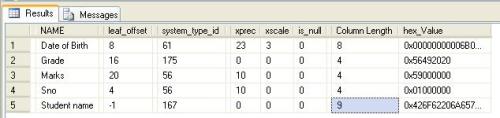
Now, we have the primary data split (Step-3) and null values (Step-4) as well. After that we need to use this code snippet to get the column data like column name, column size, precision, scale and most importantly the leaf null bit (to ensure that the column is fixed data (<=-1) or variable data sizes (>=1)) of the table.

Select * from sys.allocation_units allocunits INNER JOIN sys.partitions partitions ON (allocunits.type IN (1, 3) AND partitions.hobt_id = allocunits.container_id) OR (allocunits.type = 2 AND partitions.partition_id = allocunits.container_id) INNER JOIN sys.system_internals_partition_columns cols ON cols.partition_id = partitions.partition_id LEFT OUTER JOIN syscolumns ON syscolumns.id = partitions.object_id AND syscolumns.colid = cols.partition_column_id

And join it with our collected data table (Step-1,2,3,4) on the basis of allocunits.[Allocation_Unit_Id].Till now we know the information about the table and data,so we need to utilize this data to break [RowLog Contents 0] into table column data but in hex value. Here we need to take care as the data is either in fixed column size or in variable column size. .

Step-6:

We collected data in hex value (Step-5) with respect to each column. Now we need to convert the data with respect to its data type defined as [System_type_id]. Each type is having different mechanism
for data conversion.


--NVARCHAR ,NCHAR
WHEN system_type_id IN (231, 239) THEN  LTRIM(RTRIM(CONVERT(NVARCHAR(max),hex_Value)))

--VARCHAR,CHAR
WHEN system_type_id IN (167,175) THEN  LTRIM(RTRIM(CONVERT(VARCHAR(max),REPLACE(hex_Value, 0x00, 0x20))))

--TINY INTEGER
WHEN system_type_id = 48 THEN CONVERT(VARCHAR(MAX), CONVERT(TINYINT, CONVERT(BINARY(1), REVERSE (hex_Value))))

--SMALL INTEGER
WHEN system_type_id = 52 THEN CONVERT(VARCHAR(MAX), CONVERT(SMALLINT, CONVERT(BINARY(2), REVERSE (hex_Value))))

-- INTEGER
WHEN system_type_id = 56 THEN CONVERT(VARCHAR(MAX), CONVERT(INT, CONVERT(BINARY(4), REVERSE(hex_Value))))

-- BIG INTEGER
WHEN system_type_id = 127 THEN CONVERT(VARCHAR(MAX), CONVERT(BIGINT, CONVERT(BINARY(8), REVERSE(hex_Value))))

--DATETIME
WHEN system_type_id = 61 Then CONVERT(VARCHAR(Max),CONVERT(DATETIME,Convert(VARBINARY(max),REVERSE (hex_Value))),100)

--SMALL DATETIME
WHEN system_type_id =58 Then CONVERT(VARCHAR(Max),CONVERT(SMALLDATETIME,CONVERT(VARBINARY(MAX),REVERSE(hex_Value))),100) --SMALL DATETIME

--- NUMERIC
WHEN system_type_id = 108 THEN CONVERT(VARCHAR(MAX), CAST(CONVERT(NUMERIC(18,14), CONVERT(VARBINARY,CONVERT(VARBINARY,xprec)+CONVERT(VARBINARY,xscale))+CONVERT(VARBINARY(1),0) + hex_Value) as FLOAT))

--MONEY,SMALLMONEY
WHEN system_type_id In(60,122) THEN CONVERT(VARCHAR(MAX),Convert(MONEY,Convert(VARBINARY(MAX),Reverse(hex_Value))),2)

--- DECIMAL
WHEN system_type_id = 106 THEN CONVERT(VARCHAR(MAX), CAST(CONVERT(Decimal(38,34), Convert(VARBINARY,Convert(VARBINARY,xprec)+CONVERT(VARBINARY,xscale))+CONVERT(VARBINARY(1),0) + hex_Value) as FLOAT))

-- BIT
WHEN system_type_id = 104 THEN CONVERT(VARCHAR(MAX),CONVERT (BIT,CONVERT(BINARY(1), hex_Value)%2))

--- FLOAT
WHEN system_type_id = 62 THEN  RTRIM(LTRIM(Str(Convert(FLOAT,SIGN(CAST(Convert(VARBINARY(max),Reverse(hex_Value)) AS BIGINT)) * (1.0 + (CAST(CONVERT(VARBINARY(max),Reverse(hex_Value)) AS BIGINT) & 0x000FFFFFFFFFFFFF) * POWER(CAST(2 AS FLOAT), -52)) * POWER(CAST(2 AS FLOAT),((CAST(CONVERT(VARBINARY(max),Reverse(hex_Value)) AS BIGINT) & 0x7ff0000000000000) / EXP(52 * LOG(2))-1023))),53,LEN(hex_Value))))

--REAL
When  system_type_id =59 THEN  Left(LTRIM(STR(Cast(SIGN(CAST(Convert(VARBINARY(max),Reverse(hex_Value)) AS BIGINT))* (1.0 + (CAST(CONVERT(VARBINARY(max),Reverse(hex_Value)) AS BIGINT) & 0x007FFFFF) * POWER(CAST(2 AS Real), -23)) * POWER(CAST(2 AS Real),(((CAST(CONVERT(VARBINARY(max),Reverse(hex_Value)) AS INT) )& 0x7f800000)/ EXP(23 * LOG(2))-127))AS REAL),23,23)),8)

--BINARY,VARBINARY
WHEN system_type_id In (165,173) THEN (CASE WHEN Charindex(0x,cast('' AS XML).value('xs:hexBinary(sql:column("hex_value"))', 'varbinary(max)')) = 0 THEN '0x' ELSE '' END) +cast('' AS XML).value('xs:hexBinary(sql:column("hex_value"))', 'varchar(max)')

--UNIQUEIDENTIFIER
WHEN system_type_id =36 THEN CONVERT(VARCHAR(MAX),CONVERT(UNIQUEIDENTIFIER,hex_Value))

Step-7:

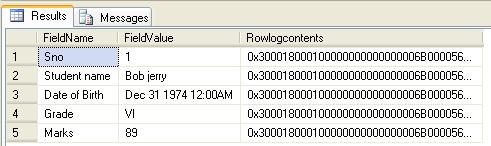
Finally we do a pivot table over the data and you will see the result. THE DELETED DATA IS BACK.

Note: This data will only for display. It is not available in your selected table but you can insert this data in your table.

I’d really appreciate your comments on my posts, whether you agree or not, do comment.

Read Full Post »

« Newer Posts