Feeds:
Posts
Comments

Adventureworks sample database launched with SQL Server 2012 and you can download it from the codeplex.

Given below are the links :

After downloading the appropriate data files lets proceed with the installation :

Installation via T-SQL :

Step 1:

You should copy the data file to any appropriate location but it should not be in the root directory due to the security issue.

If you do so, it generates error.

Step 2 :

Once you download the file, you will notice that it has only data file and not log file. So, we need to write the script given below to create the database and  in order to build a new log file, we need to use ATTACH_REBUILD_LOG.

Create Database [AdventureWorks2012]
On (FILENAME=  N'C:\Program Files\Microsoft SQL Server\MSSQL11.MSSQLSERVER\MSSQL\DATA\AdventureWorks2012_Data.mdf')
For ATTACH_REBUILD_LOG
GO

For testing purpose lets put it in the root directory :

Create Database [AdventureWorks2012]
On (FILENAME=  N'C:\AdventureWorks2012_Data.mdf')
For ATTACH_REBUILD_LOG
GO

It generates an error :
File activation failure. The physical file name “C:\Program Files\Microsoft SQL Server\MSSQL11.MSSQLSERVER\MSSQL\DATA\AdventureWorks2012_Log.ldf” may be incorrect.
Msg 5123, Level 16, State 1, Line 1
CREATE FILE encountered operating system error 5(Access is denied.) while attempting to open or create the physical file ‘C:\AdventureWorks2012_log.ldf’.
Msg 1813, Level 16, State 2, Line 1
Could not open new database ‘AdventureWorks2012’. CREATE DATABASE is aborted.

Installation via SSMS :
Step 1:

Should be same as above.

Step 2 :

Right click on the databases and click on Attach. After that click on Add button and browse the file (AdventureWorks2012_Data).

After that, if you press  OK button, it will reflect error as given below.

So, you need to select the file name (AdventureWorks2012_log.ldf) having file type “log”  and message “Not Found”  and press the Remove button.

After that press OK to finish the installation.

Now, you can see the “AdventureWorks2012” database in SSMS.

In my last post, I had written about the new feature SEQUENCE in SQL SERVER 2012. But in this post, I would like to write the difference between SEQUENCE and IDENTITY in SQL Server 2012 with examples. I hope this example will make these two concepts more clear.
Given below are the differences along with the sample source code:

S.No

Identity

Sequence

1

Dependant on table.

Independent from table.

2

Identity is a property in a table.

Example :

CREATE TABLE Table
test_Identity

(

[ID] int Identity (1,1),

[Product Name] varchar(50)

)


Sequence is an object.

Example :

CREATE SEQUENCE [dbo].[Sequence_ID]

AS [int]

START WITH 1

INCREMENT BY 1

MINVALUE 1

MAXVALUE 1000

NO CYCLE

NO CACHE

3

If you need a new ID from an identity column you need to
insert and then get new ID.

Example :

Insert into [test_Identity] Values (‘SQL Server’)

GO

SELECT @@IDENTITY AS ‘Identity’

–OR

Select SCOPE_IDENTITY() AS ‘Identity’

In the sequence, you do not need to insert new ID, you can view the new ID directly.

Example :

SELECT NEXT VALUE
FOR dbo.[Sequence_ID]


4

You cannot perform a cycle in identity column. Meaning, you cannot restart the counter after a
particular interval.


In the sequence, you can simply add one property to make it a cycle.

Example :

ALTER SEQUENCE [dbo].[Sequence_ID]

CYCLE;

5

You cannot cache Identity column property.

Sequence can be easily cached by just setting cache property of
sequence. It also improves the performance.

Example :

ALTER SEQUENCE [dbo].[Sequence_ID]

CACHE 3;

6

You cannot remove the identity column from the table directly.

The sequence is not table dependent so you can easily remove it

Example :

Create table dbo.[test_Sequence]

(

[ID] int,

[Product Name] varchar(50)

)

GO

–First Insert With Sequence object

INSERT INTO dbo.test_Sequence ([ID],[Product Name]) VALUES (NEXT VALUE FOR [Ticket] , ‘MICROSOFT SQL SERVER 2008’)

GO

–Second Insert without Sequence

INSERT INTO dbo.test_Sequence ([ID],[Product Name]) VALUES (2 , ‘MICROSOFT SQL SERVER 2012’)

7

You cannot define the maximum value in identity column it is
based on the data type limit.

Here you can set up its maximum value.


Example :

ALTER SEQUENCE [dbo].[Sequence_ID]

MAXVALUE 2000;

8

You can reseed it but cannot change the step size.

Example :

DBCC CHECKIDENT (test_Identity, RESEED, 4)


You can reseed as well as change the step size.

Example :

ALTER SEQUENCE [dbo].[Sequence_ID]

RESTART WITH 7

INCREMENT BY 2;

9

You cannot generate range from identity.

You can generate a range of sequence
values from a sequence object
with the help of sp_sequence_get_range.

Microsoft launched many new features in the SQL server 2012 and one of its best features is SEQUENCE Object.
Let me explain it with a real world example:

It generates a sequence (Auto number) without associating with the table globally. (In earlier versions, we had to generate sequence manually).
The sequence should be of numeric data type (tinyint, smallint, int, bigint, decimal and numeric (scale should be zero)) and it can be generated in an ascending or descending order at a particular interval and we can also define the (cycle) to restart the sequence.

SYNTAX :
CREATE SEQUENCE [schema_name].sequence_name
[ AS [ built_in_integer_type | user-defined_integer_type ] ]
[ START WITH ]
[ INCREMENT BY ]
[ { MINVALUE [ ] } | { NO MINVALUE } ]
[ { MAXVALUE [ ] } | { NO MAXVALUE } ]
[ CYCLE | { NO CYCLE } ]
[ { CACHE [ ] } | { NO CACHE } ]
[ ; ]
But, the question is if we have an identity property, then why do we need sequence? Given below is an example that will demonstrate the importance of sequence object.
Example :
We developed a ticketing system in one of the service industries and the requirement was that we had to create tickets for multiple services.
And the ticket should not be repeated in any service. And once we reach 1000 tickets, we need to restart it from ‘1’.
But, we were maintaining multiple service data in multiple tables. So we need to maintain a global unique auto-number and here it comes to Sequence.

Lets proceed now step by step.

Step 1 :
First, you need to create a sequence object namely “Ticket”

CREATE SEQUENCE [dbo].[Ticket]
AS [int]
START WITH 1
INCREMENT BY 1
MINVALUE 1
MAXVALUE 1000
CYCLE
CACHE
GO

Step 2 :
You need to create two tables to maintain different types of services in different tables.

Create table tbl_Renewal_Application(
[TicketNo] INT NOT NULL,
[App Date] datetime,
[Comments] varchar(max)

Create table tbl_New_Application(
[TicketNo] INT NOT NULL,
[App Date] datetime,
[Comments] varchar(max))

Step 3:
Now, you need to insert the [Ticket No] (Auto Increment) in different tables without duplication and should be consistent.

INSERT tbl_Renewal_Application ([TicketNo], [App Date],[Comments])
VALUES
(NEXT VALUE FOR [Ticket], Getdate(),'Renewal-1')
GO
INSERT tbl_New_Application ([TicketNo], [App Date],[Comments])
VALUES
(NEXT VALUE FOR [Ticket] , Getdate(),'New App-1')
GO
INSERT tbl_Renewal_Application ([TicketNo], [App Date],[Comments])
VALUES
(NEXT VALUE FOR [Ticket] , Getdate(),'Renewal-2')
GO
INSERT tbl_New_Application ([TicketNo], [App Date],[Comments])
VALUES
(NEXT VALUE FOR [Ticket] , Getdate(),'New App-2')

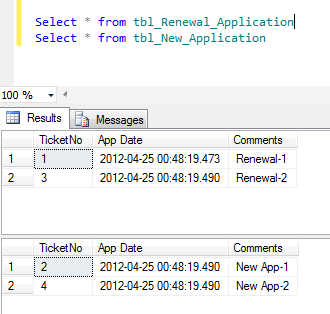
Now, if you browse the data from both tables, you can see the sequence number (Auto Number) available in the same sequence as we inserted into the table.
Here is the result :

Select * from tbl_Renewal_Application
Select * from tbl_New_Application


The beauty of this object is, if you need a new counter, you need not insert value in the table and then get the counter. By simply executing one query you can get the next counter.
Here is the query.

SELECT NEXT VALUE FOR dbo.[ticket]

–Result is 5
Note : At the time of implementation, if you need to start your first counter from 500 then, you need to set the start property of sequence to 500.

Sometimes, we have a request to create few hundred users in sql server specially at the time of new deployment.
The first solution is we can create users one by one, but it takes some time to create in the SQL Server.
The second solution is using Microsoft Excel. In this case, we need to enter all the users, its password and related information in excel sheet, and using this script we can create the sql script from this excel sheet.

To create SQL Authentication users in SQL, please enter your data in this excel sheet format (kindly do not change the header name) :
Download excel sheet for SQL.

To create Windows Authentication users in SQL, please enter your data in this excel sheet format (kindly do not change the header name) :
Download excel sheet for Windows.

Given below is the script with examples:

CREATE PROCEDURE CREATE_MULTIPLE_LOGIN_PROC
@Excel_File_Name_Path VARCHAR(MAX),
@Excel_Sheet_Name VARCHAR(MAX),
@Authentication_Type VARCHAR(MAX)
AS

DECLARE @SQL VARCHAR(MAX)

SET @SQL=''
SET @Excel_Sheet_Name =QUOTENAME (@Excel_Sheet_Name + '$' )--Add "$" to the excel sheet name to make it accessable.
SET @Excel_File_Name_Path='''Excel 4.0;Database=' + @Excel_File_Name_Path + ''

CREATE TABLE #temp_Data
(
[SNO]	 INT,
[SCRIPT] NVARCHAR(MAX)
)
IF @Authentication_Type ='SQL' -- If Authentication Type is SQL
Begin
SET @SQL = 'INSERT INTO #temp_Data ' + 'SELECT  [SNO],'+ '''CREATE LOGIN ''
+ QUOTENAME([LOGIN NAME])
+ '' WITH PASSWORD=N''''''+ [PASSWORD] + ''''''
,CHECK_EXPIRATION=''+[CHECK_EXPIRATION]+ ''
,CHECK_POLICY=''+[CHECK_POLICY]+ ''
,DEFAULT_DATABASE=''+QUOTENAME([DEFAULT_DATABASE])+ ''
,DEFAULT_LANGUAGE=''+QUOTENAME([DEFAULT_LANGUAGE])+ '''''
+ ' AS [DATA] FROM OPENROWSET(''Microsoft.Jet.OLEDB.4.0'', ' + @Excel_File_Name_Path + ''', ' +
'''SELECT * FROM '+@Excel_Sheet_Name + ''')'
Print @SQL
EXEC(@SQL)

SET @SQL = ''
SET @SQL = 'INSERT INTO #temp_Data Select [SNO]
,''EXEC sys.sp_addsrvrolemember @loginame =N''''''+ [LOGIN NAME] + ''''''
, @rolename =N''''''+[FieldValue] + ''''''''
FROM (
Select [SNO],
[LOGIN NAME],
CONVERT(NVARCHAR(Max),[SERVER ROLE 1]) as [SERVER ROLE 1]  ,
CONVERT(NVARCHAR(Max),[SERVER ROLE 2]) as [SERVER ROLE 2]  ,
CONVERT(NVARCHAR(Max),[SERVER ROLE 3]) as [SERVER ROLE 3]  ,
CONVERT(NVARCHAR(Max),[SERVER ROLE 4]) as [SERVER ROLE 4]  ,
CONVERT(NVARCHAR(Max),[SERVER ROLE 5]) as [SERVER ROLE 5]  ,
CONVERT(NVARCHAR(Max),[SERVER ROLE 6]) as [SERVER ROLE 6]  ,
CONVERT(NVARCHAR(Max),[SERVER ROLE 7]) as [SERVER ROLE 7]  ,
CONVERT(NVARCHAR(Max),[SERVER ROLE 8]) as [SERVER ROLE 8]  ,
CONVERT(NVARCHAR(Max),[SERVER ROLE 9]) as [SERVER ROLE 9]  ,
CONVERT(NVARCHAR(Max),[SERVER ROLE 10]) as [SERVER ROLE 10]
FROM OPENROWSET(''Microsoft.Jet.OLEDB.4.0'', ' + @Excel_File_Name_Path + ''', ' +
'''SELECT * FROM '+@Excel_Sheet_Name + '''))Main
UNPIVOT(FieldValue  FOR FieldName IN (
[SERVER ROLE 1] ,
[SERVER ROLE 2] ,
[SERVER ROLE 3] ,
[SERVER ROLE 4] ,
[SERVER ROLE 5] ,
[SERVER ROLE 6] ,
[SERVER ROLE 7] ,
[SERVER ROLE 8] ,
[SERVER ROLE 9] ,
[SERVER ROLE 10]
)
)Sup'
Print @SQL
EXEC(@SQL)
END
ELSE IF @Authentication_Type ='Windows'
BEGIN
---Create
SET @SQL = 'INSERT INTO #temp_Data ' + 'SELECT  [SNO],'+ '''CREATE LOGIN ''
+ QUOTENAME([LOGIN NAME]) + ''
FROM WINDOWS WITH DEFAULT_DATABASE=''+QUOTENAME([DEFAULT_DATABASE])+ ''
, DEFAULT_LANGUAGE=''+QUOTENAME([DEFAULT_LANGUAGE])+ '''''
+ ' AS [DATA] FROM OPENROWSET(''Microsoft.Jet.OLEDB.4.0'',
' + @Excel_File_Name_Path + ''', ' +
'''SELECT * FROM '+@Excel_Sheet_Name + ''')'
Print @SQL
EXEC(@SQL)
SET @SQL = ''
END

Select [SCRIPT] from #temp_Data Order By [SNO],[SCRIPT]
GO
--Syntax
--CREATE_MULTIPLE_LOGIN_PROC 'Excel Sheet Path','Sheet Name (By Default it is sheet1)','Authentication Type'
--Example 1 :
CREATE_MULTIPLE_LOGIN_PROC 'E:\login_list-for-sql.xls','Sheet1','SQL' -- To Create SQL users
GO
--Result

--Example 2 :
CREATE_MULTIPLE_LOGIN_PROC 'E:\login_list-for-Windows.xls','Sheet1','Windows' -- To Create Windows users
--Result

I welcome your valuable feedback/input.

Here is a solution to convert Iranian Calendar (also known as Persian calendar or the Jalaali Calendar) to Gregorian Calendar & vise versa in SQL server.
To develop this solution, we used Julian calendar as an intermediary to convert it & vise versa.

Here is the source code to convert Iranian Calendar to Gregorian Calendar with example:

--First twe need to convert Persian calendar date to Julian Calendar date
Create FUNCTION [dbo].[UDF_Persian_To_Julian](@iYear int,@iMonth int,@iDay int)
RETURNS bigint
AS
Begin

Declare @PERSIAN_EPOCH  as int
Declare @epbase as bigint
Declare @epyear as bigint
Declare @mdays as bigint
Declare @Jofst  as Numeric(18,2)
Declare @jdn bigint

Set @PERSIAN_EPOCH=1948321
Set @Jofst=2415020.5

If @iYear>=0
Begin
Set @epbase=@iyear-474
End
Else
Begin
Set @epbase = @iYear - 473
End
set @epyear=474 + (@epbase%2820)
If @iMonth<=7
Begin
Set @mdays=(Convert(bigint,(@iMonth) - 1) * 31)
End
Else
Begin
Set @mdays=(Convert(bigint,(@iMonth) - 1) * 30+6)
End
Set @jdn =Convert(int,@iday) + @mdays+ Cast(((@epyear * 682) - 110) / 2816 as int)  + (@epyear - 1) * 365 + Cast(@epbase / 2820 as int) * 1029983 + (@PERSIAN_EPOCH - 1)
RETURN @jdn
End
Go
--Secondly, convert Julian calendar date to Gregorian to achieve the target.
Create FUNCTION [dbo].[UDF_Julian_To_Gregorian] (@jdn bigint)
Returns nvarchar(11)
as
Begin
Declare @Jofst  as Numeric(18,2)
Set @Jofst=2415020.5
Return Convert(nvarchar(11),Convert(datetime,(@jdn- @Jofst),113),110)
End
Go
-- Here is the example
Select dbo.[UDF_Julian_To_Gregorian](dbo.[UDF_Persian_To_Julian](1391,1,30))
--Result is 04-18-2012

Here is the source code to convert Gregorian Calendar to Iranian Calendar with example:

Create Function dbo.[UDF_Gregorian_To_Persian] (@date datetime)
Returns nvarchar(50)
as
Begin
Declare @depoch as bigint
Declare @cycle  as bigint
Declare @cyear  as bigint
Declare @ycycle as bigint
Declare @aux1 as bigint
Declare @aux2 as bigint
Declare @yday as bigint
Declare @Jofst  as Numeric(18,2)
Declare @jdn bigint

Declare @iYear   As Integer
Declare @iMonth  As Integer
Declare @iDay    As Integer

Set @Jofst=2415020.5
Set @jdn=Round(Cast(@date as int)+ @Jofst,0)

Set @depoch = @jdn - [dbo].[UDF_Persian_To_Julian](475, 1, 1)
Set @cycle = Cast(@depoch / 1029983 as int)
Set @cyear = @depoch%1029983

If @cyear = 1029982
Begin
Set @ycycle = 2820
End
Else
Begin
Set @aux1 = Cast(@cyear / 366 as int)
Set @aux2 = @cyear%366
Set @ycycle = Cast(((2134 * @aux1) + (2816 * @aux2) + 2815) / 1028522 as int) + @aux1 + 1
End

Set @iYear = @ycycle + (2820 * @cycle) + 474

If @iYear <= 0
Begin
Set @iYear = @iYear - 1
End
Set @yday = (@jdn - [dbo].[UDF_Persian_To_Julian](@iYear, 1, 1)) + 1
If @yday <= 186
Begin
Set @iMonth = CEILING(Convert(Numeric(18,4),@yday) / 31)
End
Else
Begin
Set @iMonth = CEILING((Convert(Numeric(18,4),@yday) - 6) / 30)
End
Set @iDay = (@jdn - [dbo].[UDF_Persian_To_Julian](@iYear, @iMonth, 1)) + 1

Return Convert(nvarchar(50),@iDay) + '-' +   Convert(nvarchar(50),@iMonth) +'-' + Convert(nvarchar(50),@iYear)
End
GO
-- Here is the example
Select dbo.[UDF_Gregorian_To_Persian]('2012-04-18') as [Persian Date]
--Result is 30-1-1391

By default, SQL Server takes the backup in the following location (‘C:\Program Files\Microsoft SQL Server\MSSQL.1\MSSQL\Backup\’). But if you don’t take the backup in this location, each time you need to change the backup path.To avoid this, you can set your default database backup path.

Here is the solution :
You can change the default backup path from the given below script.

DECLARE @HkeyLocal nvarchar(18)
DECLARE @BackupDirectory nvarchar(512)
DECLARE @InstanceRegPath sysname
DECLARE @MSSqlServerRegPath nvarchar(31)
DECLARE @NewPath nvarchar(100)

SET @HkeyLocal=N'HKEY_LOCAL_MACHINE'
SET @MSSqlServerRegPath=N'SOFTWARE\Microsoft\MSSQLServer'
SET @InstanceRegPath=@MSSqlServerRegPath + N'\MSSQLServer'

EXEC xp_instance_regread @HkeyLocal, @InstanceRegPath, N'BackupDirectory', @BackupDirectory OUTPUT
SELECT @BackupDirectory -- Read the default backup directory path

-- Update/Change the default backup directory path to @NewPath
SET @NewPath='D:\DBBackup' -- Change the new default backup folder here
EXEC xp_instance_regwrite @HkeyLocal,@InstanceRegPath, N'BackupDirectory', REG_SZ,@NewPath

Here is screen image of before processing this script :

Here is the screen image after processing this script :

Your feedback is very much appreciated. Please do write.

I was working on “How to recover truncated data from SQL Server” from last couple of weeks and finally I was successful.

Now, it is very easy to recover truncated data from your SQL server 2005 or above.(Note: This script can recover following data types & compatible with CS collation.Also, your database recovery model should be FULL).

  • tinyint
  • smallint
  • int
  • bigint
  • bit
  • char
  • varchar
  • nchar
  • nvarchar
  • datetime
  • smalldatetime
  • money
  • smallmoney
  • decimal
  • numeric
  • real
  • float
  • binary
  • varbinary
  • uniqueidentifier

Let me explain this issue demonstrating simple example.

--Create Table
CREATE TABLE [dbo].[Student](
[Sno] [int] NOT NULL,
[Student ID] nvarchar(6) Not NULL ,
[Student name] [varchar](50) NOT NULL,
[Date of Birth]  datetime not null,
[Weight] [int] NULL)
--Insert data into table
Insert into dbo.[Student] values (1,'STD001','Bob','2003-12-31',40)
Insert into dbo.[Student] values (2,'STD002','Alexander','2004-11-15',35)
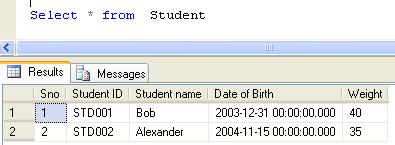
--Check the existence of the data
Select * from dbo.[Student]
--truncate data
Truncate Table dbo.Student
--Verify the data has been truncated
Select * from dbo.[Student]

Now, you need to create this procedure to recover your truncated data

Create PROCEDURE Recover_Truncated_Data_Proc
@Database_Name NVARCHAR(MAX),
@SchemaName_n_TableName NVARCHAR(MAX),
@Date_From datetime='1900/01/01',
@Date_To datetime ='9999/12/31'
AS
DECLARE @Fileid INT
DECLARE @Pageid INT
DECLARE @Slotid INT

DECLARE @ConsolidatedPageID VARCHAR(MAX)
Declare @AllocUnitID as bigint
Declare @TransactionID as VARCHAR(MAX)

/*  Pick The actual data
*/
declare @temppagedata table
(
[ParentObject] sysname,
[Object] sysname,
[Field] sysname,
[Value] sysname)

declare @pagedata table
(
[Page ID] sysname,
[AllocUnitId] bigint,
[ParentObject] sysname,
[Object] sysname,
[Field] sysname,
[Value] sysname)

DECLARE Page_Data_Cursor CURSOR FOR
/*We need to filter LOP_MODIFY_ROW,LOP_MODIFY_COLUMNS from log for modified records & Get its Slot No, Page ID & AllocUnit ID*/
SELECT LTRIM(RTRIM(Replace([Description],'Deallocated',''))) AS [PAGE ID]
,[Slot ID],[AllocUnitId]
FROM    sys.fn_dblog(NULL, NULL)
WHERE
AllocUnitId IN
(Select [Allocation_unit_id] from sys.allocation_units allocunits
INNER JOIN sys.partitions partitions ON (allocunits.type IN (1, 3)
AND partitions.hobt_id = allocunits.container_id) OR (allocunits.type = 2
AND partitions.partition_id = allocunits.container_id)
Where object_id=object_ID('' + @SchemaName_n_TableName + ''))
AND Operation IN ('LOP_MODIFY_ROW') AND [Context] IN ('LCX_PFS')
AND Description Like '%Deallocated%'
/*Use this subquery to filter the date*/

AND [TRANSACTION ID] IN (SELECT DISTINCT [TRANSACTION ID] FROM    sys.fn_dblog(NULL, NULL)
WHERE Context IN ('LCX_NULL') AND Operation in ('LOP_BEGIN_XACT')
AND [Transaction Name]='TRUNCATE TABLE'
AND  CONVERT(NVARCHAR(11),[Begin Time]) BETWEEN @Date_From AND @Date_To)

/****************************************/

GROUP BY [Description],[Slot ID],[AllocUnitId]
ORDER BY [Slot ID]

OPEN Page_Data_Cursor

FETCH NEXT FROM Page_Data_Cursor INTO @ConsolidatedPageID, @Slotid,@AllocUnitID

WHILE @@FETCH_STATUS = 0
BEGIN
DECLARE @hex_pageid AS VARCHAR(Max)
/*Page ID contains File Number and page number It looks like 0001:00000130.
In this example 0001 is file Number &  00000130 is Page Number & These numbers are in Hex format*/
SET @Fileid=SUBSTRING(@ConsolidatedPageID,0,CHARINDEX(':',@ConsolidatedPageID)) -- Seperate File ID from Page ID
SET @hex_pageid ='0x'+ SUBSTRING(@ConsolidatedPageID,CHARINDEX(':',@ConsolidatedPageID)+1,Len(@ConsolidatedPageID))  ---Seperate the page ID
SELECT @Pageid=Convert(INT,cast('' AS XML).value('xs:hexBinary(substring(sql:variable("@hex_pageid"),sql:column("t.pos")) )', 'varbinary(max)')) -- Convert Page ID from hex to integer
FROM (SELECT CASE substring(@hex_pageid, 1, 2) WHEN '0x' THEN 3 ELSE 0 END) AS t(pos)

DELETE @temppagedata
-- Now we need to get the actual data (After truncate) from the page

INSERT INTO @temppagedata EXEC( 'DBCC PAGE(' + @DataBase_Name + ', ' + @fileid + ', ' + @pageid + ', 1) with tableresults,no_infomsgs;');
---Check if any index page is there
If (Select Count(*) From @temppagedata Where [Field]='Record Type' And [Value]='INDEX_RECORD')=0
Begin
DELETE @temppagedata
INSERT INTO @temppagedata EXEC( 'DBCC PAGE(' + @DataBase_Name + ', ' + @fileid + ', ' + @pageid + ', 3) with tableresults,no_infomsgs;');
End
Else
Begin
DELETE @temppagedata
End

INSERT INTO @pagedata SELECT @ConsolidatedPageID,@AllocUnitID,[ParentObject],[Object],[Field] ,[Value] FROM @temppagedata
FETCH NEXT FROM Page_Data_Cursor INTO  @ConsolidatedPageID, @Slotid,@AllocUnitID
END

CLOSE Page_Data_Cursor
DEALLOCATE Page_Data_Cursor

DECLARE @Newhexstring VARCHAR(MAX);

DECLARE @ModifiedRawData TABLE
(
[ID] INT IDENTITY(1,1),
[PAGE ID] VARCHAR(MAX),
[Slot ID] INT,
[AllocUnitId] BIGINT,
[RowLog Contents 0_var] VARCHAR(MAX),
[RowLog Contents 0] VARBINARY(8000)
)
--The truncated data is in multiple rows in the page, so we need to convert it into one row as a single hex value.
--This hex value is in string format

INSERT INTO @ModifiedRawData ([PAGE ID],[Slot ID],[AllocUnitId]
,[RowLog Contents 0_var])
SELECT [Page ID],Substring([ParentObject],CHARINDEX('Slot', [ParentObject])+4, (CHARINDEX('Offset', [ParentObject])-(CHARINDEX('Slot', [ParentObject])+4)) ) as [Slot ID]
,[AllocUnitId]
,(
SELECT REPLACE(STUFF((SELECT REPLACE(SUBSTRING([Value],CHARINDEX(':',[Value])+1,CHARINDEX('†',[Value])-CHARINDEX(':',[Value])),'†','')
FROM @pagedata C  WHERE B.[Page ID]= C.[Page ID] And Substring(B.[ParentObject],CHARINDEX('Slot', B.[ParentObject])+4, (CHARINDEX('Offset', B.[ParentObject])-(CHARINDEX('Slot', B.[ParentObject])+4)) )=Substring(C.[ParentObject],CHARINDEX('Slot', C.[ParentObject])+4, (CHARINDEX('Offset', C.[ParentObject])-(CHARINDEX('Slot', C.[ParentObject])+4)) ) And
[Object] Like '%Memory Dump%'
FOR XML PATH('') ),1,1,'') ,' ','')
) AS [Value]
From @pagedata B
Where [Object] Like '%Memory Dump%'
Group By [Page ID],[ParentObject],[AllocUnitId]
Order By [Slot ID]

-- Convert the hex value data in string, convert it into Hex value as well.
UPDATE @ModifiedRawData  SET [RowLog Contents 0] = cast('' AS XML).value('xs:hexBinary(substring(sql:column("[RowLog Contents 0_var]"), 0) )', 'varbinary(max)')
FROM @ModifiedRawData

DECLARE @RowLogContents VARBINARY(8000)
Declare @AllocUnitName NVARCHAR(Max)
Declare @SQL NVARCHAR(Max)
DECLARE @bitTable TABLE
(
[ID] INT,
[Bitvalue] INT
)
----Create table to set the bit position of one byte.

INSERT INTO @bitTable
SELECT 0,2 UNION ALL
SELECT 1,2 UNION ALL
SELECT 2,4 UNION ALL
SELECT 3,8 UNION ALL
SELECT 4,16 UNION ALL
SELECT 5,32 UNION ALL
SELECT 6,64 UNION ALL
SELECT 7,128

--Create table to collect the row data.
DECLARE @DeletedRecords TABLE
(
[RowLogContents]	VARBINARY(8000),
[AllocUnitID]		BIGINT,
[Transaction ID]	NVARCHAR(Max),
[Slot ID]           INT,
[FixedLengthData]	SMALLINT,
[TotalNoOfCols]		SMALLINT,
[NullBitMapLength]	SMALLINT,
[NullBytes]			VARBINARY(8000),
[TotalNoofVarCols]	SMALLINT,
[ColumnOffsetArray]	VARBINARY(8000),
[VarColumnStart]	SMALLINT,
[NullBitMap]		VARCHAR(MAX)
)
--Create a common table expression to get all the row data plus how many bytes we have for each row.
;WITH RowData AS (
SELECT

[RowLog Contents 0] AS [RowLogContents]

,[AllocUnitID] AS [AllocUnitID]

,[ID] AS [Transaction ID]

,[Slot ID] as [Slot ID]
--[Fixed Length Data] = Substring (RowLog content 0, Status Bit A+ Status Bit B + 1,2 bytes)
,CONVERT(SMALLINT, CONVERT(BINARY(2), REVERSE(SUBSTRING([RowLog Contents 0], 2 + 1, 2)))) AS [FixedLengthData]  --@FixedLengthData

--[TotalnoOfCols] =  Substring (RowLog content 0, [Fixed Length Data] + 1,2 bytes)
,CONVERT(INT, CONVERT(BINARY(2), REVERSE(SUBSTRING([RowLog Contents 0], CONVERT(SMALLINT, CONVERT(BINARY(2)
,REVERSE(SUBSTRING([RowLog Contents 0], 2 + 1, 2)))) + 1, 2)))) as  [TotalNoOfCols]

--[NullBitMapLength]=ceiling([Total No of Columns] /8.0)
,CONVERT(INT, ceiling(CONVERT(INT, CONVERT(BINARY(2), REVERSE(SUBSTRING([RowLog Contents 0], CONVERT(SMALLINT, CONVERT(BINARY(2)
,REVERSE(SUBSTRING([RowLog Contents 0], 2 + 1, 2)))) + 1, 2))))/8.0)) as [NullBitMapLength]

--[Null Bytes] = Substring (RowLog content 0, Status Bit A+ Status Bit B + [Fixed Length Data] +1, [NullBitMapLength] )
,SUBSTRING([RowLog Contents 0], CONVERT(SMALLINT, CONVERT(BINARY(2), REVERSE(SUBSTRING([RowLog Contents 0], 2 + 1, 2)))) + 3,
CONVERT(INT, ceiling(CONVERT(INT, CONVERT(BINARY(2), REVERSE(SUBSTRING([RowLog Contents 0], CONVERT(SMALLINT, CONVERT(BINARY(2)
,REVERSE(SUBSTRING([RowLog Contents 0], 2 + 1, 2)))) + 1, 2))))/8.0))) as [NullBytes]

--[TotalNoofVarCols] = Substring (RowLog content 0, Status Bit A+ Status Bit B + [Fixed Length Data] +1, [Null Bitmap length] + 2 )
,(CASE WHEN SUBSTRING([RowLog Contents 0], 1, 1) In (0x30,0x70) THEN
CONVERT(INT, CONVERT(BINARY(2), REVERSE(SUBSTRING([RowLog Contents 0],
CONVERT(SMALLINT, CONVERT(BINARY(2), REVERSE(SUBSTRING([RowLog Contents 0], 2 + 1, 2)))) + 3
+ CONVERT(INT, ceiling(CONVERT(INT, CONVERT(BINARY(2), REVERSE(SUBSTRING([RowLog Contents 0], CONVERT(SMALLINT, CONVERT(BINARY(2)
,REVERSE(SUBSTRING([RowLog Contents 0], 2 + 1, 2)))) + 1, 2))))/8.0)), 2))))  ELSE null  END) AS [TotalNoofVarCols]

--[ColumnOffsetArray]= Substring (RowLog content 0, Status Bit A+ Status Bit B + [Fixed Length Data] +1, [Null Bitmap length] + 2 , [TotalNoofVarCols]*2 )
,(CASE WHEN SUBSTRING([RowLog Contents 0], 1, 1) In (0x30,0x70) THEN
SUBSTRING([RowLog Contents 0]
, CONVERT(SMALLINT, CONVERT(BINARY(2), REVERSE(SUBSTRING([RowLog Contents 0], 2 + 1, 2)))) + 3
+ CONVERT(INT, ceiling(CONVERT(INT, CONVERT(BINARY(2), REVERSE(SUBSTRING([RowLog Contents 0], CONVERT(SMALLINT, CONVERT(BINARY(2)
,REVERSE(SUBSTRING([RowLog Contents 0], 2 + 1, 2)))) + 1, 2))))/8.0)) + 2
, (CASE WHEN SUBSTRING([RowLog Contents 0], 1, 1) In (0x30,0x70) THEN
CONVERT(INT, CONVERT(BINARY(2), REVERSE(SUBSTRING([RowLog Contents 0],
CONVERT(SMALLINT, CONVERT(BINARY(2), REVERSE(SUBSTRING([RowLog Contents 0], 2 + 1, 2)))) + 3
+ CONVERT(INT, ceiling(CONVERT(INT, CONVERT(BINARY(2), REVERSE(SUBSTRING([RowLog Contents 0], CONVERT(SMALLINT, CONVERT(BINARY(2)
,REVERSE(SUBSTRING([RowLog Contents 0], 2 + 1, 2)))) + 1, 2))))/8.0)), 2))))  ELSE null  END)
* 2)  ELSE null  END) AS [ColumnOffsetArray]

--	Variable column Start = Status Bit A+ Status Bit B + [Fixed Length Data] + [Null Bitmap length] + 2+([TotalNoofVarCols]*2)
,CASE WHEN SUBSTRING([RowLog Contents 0], 1, 1)In (0x30,0x70)
THEN  (
CONVERT(SMALLINT, CONVERT(BINARY(2), REVERSE(SUBSTRING([RowLog Contents 0], 2 + 1, 2)))) + 4

+ CONVERT(INT, ceiling(CONVERT(INT, CONVERT(BINARY(2), REVERSE(SUBSTRING([RowLog Contents 0], CONVERT(SMALLINT, CONVERT(BINARY(2)
,REVERSE(SUBSTRING([RowLog Contents 0], 2 + 1, 2)))) + 1, 2))))/8.0))

+ ((CASE WHEN SUBSTRING([RowLog Contents 0], 1, 1) In (0x30,0x70) THEN
CONVERT(INT, CONVERT(BINARY(2), REVERSE(SUBSTRING([RowLog Contents 0],
CONVERT(SMALLINT, CONVERT(BINARY(2), REVERSE(SUBSTRING([RowLog Contents 0], 2 + 1, 2)))) + 3
+ CONVERT(INT, ceiling(CONVERT(INT, CONVERT(BINARY(2), REVERSE(SUBSTRING([RowLog Contents 0], CONVERT(SMALLINT, CONVERT(BINARY(2)
,REVERSE(SUBSTRING([RowLog Contents 0], 2 + 1, 2)))) + 1, 2))))/8.0)), 2))))  ELSE null  END) * 2))

ELSE null End AS [VarColumnStart]
From @ModifiedRawData
),

---Use this technique to repeate the row till the no of bytes of the row.
N1 (n) AS (SELECT 1 UNION ALL SELECT 1),
N2 (n) AS (SELECT 1 FROM N1 AS X, N1 AS Y),
N3 (n) AS (SELECT 1 FROM N2 AS X, N2 AS Y),
N4 (n) AS (SELECT ROW_NUMBER() OVER(ORDER BY X.n)
FROM N3 AS X, N3 AS Y)

insert into @DeletedRecords
Select	 RowLogContents
,[AllocUnitID]
,[Transaction ID]
,[Slot ID]
,[FixedLengthData]
,[TotalNoOfCols]
,[NullBitMapLength]
,[NullBytes]
,[TotalNoofVarCols]
,[ColumnOffsetArray]
,[VarColumnStart]
--Get the Null value against each column (1 means null zero means not null)
,[NullBitMap]=(REPLACE(STUFF((SELECT ',' +
(CASE WHEN [ID]=0 THEN CONVERT(NVARCHAR(1),(SUBSTRING(NullBytes, n, 1) % 2))  ELSE CONVERT(NVARCHAR(1),((SUBSTRING(NullBytes, n, 1) / [Bitvalue]) % 2)) END) --as [nullBitMap]
FROM
N4 AS Nums
Join RowData AS C ON n<=NullBitMapLength
Cross Join @bitTable WHERE C.[RowLogContents]=D.[RowLogContents] ORDER BY [RowLogContents],n ASC FOR XML PATH('')),1,1,''),',',''))
FROM RowData D

CREATE TABLE [#temp_Data]
(
[FieldName]  VARCHAR(MAX) COLLATE database_default NOT NULL,
[FieldValue] VARCHAR(MAX) COLLATE database_default NOT NULL,
[Rowlogcontents] VARBINARY(8000),
[Transaction ID] VARCHAR(MAX) COLLATE database_default NOT NULL,
[Slot ID] int
)
---Create common table expression and join it with the rowdata table
--to get each column details
;With CTE AS (
/*This part is for variable data columns*/
SELECT Rowlogcontents,
[Transaction ID],
[Slot ID],
NAME ,
cols.leaf_null_bit AS nullbit,
leaf_offset,
ISNULL(syscolumns.length, cols.max_length) AS [length],
cols.system_type_id,
cols.leaf_bit_position AS bitpos,
ISNULL(syscolumns.xprec, cols.precision) AS xprec,
ISNULL(syscolumns.xscale, cols.scale) AS xscale,
SUBSTRING([nullBitMap], cols.leaf_null_bit, 1) AS is_null,
--Calculate the variable column size from the variable column offset array
(CASE WHEN leaf_offset<1 and SUBSTRING([nullBitMap], cols.leaf_null_bit, 1)=0 THEN
CONVERT(SMALLINT, CONVERT(BINARY(2), REVERSE (SUBSTRING ([ColumnOffsetArray], (2 * leaf_offset*-1) - 1, 2)))) ELSE 0 END) AS [Column value Size],

---Calculate the column length
(CASE WHEN leaf_offset<1 and SUBSTRING([nullBitMap], cols.leaf_null_bit, 1)=0 THEN  CONVERT(SMALLINT, CONVERT(BINARY(2), REVERSE (SUBSTRING ([ColumnOffsetArray], (2 * (leaf_offset*-1)) - 1, 2))))
- ISNULL(NULLIF(CONVERT(SMALLINT, CONVERT(BINARY(2), REVERSE (SUBSTRING ([ColumnOffsetArray], (2 * ((leaf_offset*-1) - 1)) - 1, 2)))), 0), [varColumnStart])
ELSE 0 END) AS [Column Length]

--Get the Hexa decimal value from the RowlogContent
--HexValue of the variable column=Substring([Column value Size] - [Column Length] + 1,[Column Length])
--This is the data of your column but in the Hexvalue
,CASE WHEN SUBSTRING([nullBitMap], cols.leaf_null_bit, 1)=1 THEN NULL ELSE
SUBSTRING(Rowlogcontents,((CASE WHEN leaf_offset<1 and SUBSTRING([nullBitMap], cols.leaf_null_bit, 1)=0 THEN CONVERT(SMALLINT, CONVERT(BINARY(2), REVERSE (SUBSTRING ([ColumnOffsetArray], (2 * leaf_offset*-1) - 1, 2)))) ELSE 0 END)
- ((CASE WHEN leaf_offset<1 and SUBSTRING([nullBitMap], cols.leaf_null_bit, 1)=0 THEN  CONVERT(SMALLINT, CONVERT(BINARY(2), REVERSE (SUBSTRING ([ColumnOffsetArray], (2 * (leaf_offset*-1)) - 1, 2))))
- ISNULL(NULLIF(CONVERT(SMALLINT, CONVERT(BINARY(2), REVERSE (SUBSTRING ([ColumnOffsetArray], (2 * ((leaf_offset*-1) - 1)) - 1, 2)))), 0), [varColumnStart])
ELSE 0 END))) + 1,((CASE WHEN leaf_offset<1 and SUBSTRING([nullBitMap], cols.leaf_null_bit, 1)=0 THEN  CONVERT(SMALLINT, CONVERT(BINARY(2), REVERSE (SUBSTRING ([ColumnOffsetArray], (2 * (leaf_offset*-1)) - 1, 2))))
- ISNULL(NULLIF(CONVERT(SMALLINT, CONVERT(BINARY(2), REVERSE (SUBSTRING ([ColumnOffsetArray], (2 * ((leaf_offset*-1) - 1)) - 1, 2)))), 0), [varColumnStart])
ELSE 0 END))) END AS hex_Value

FROM @DeletedRecords A
Inner Join sys.allocation_units allocunits On A.[AllocUnitId]=allocunits.[Allocation_Unit_Id]
INNER JOIN sys.partitions partitions ON (allocunits.type IN (1, 3)
AND partitions.hobt_id = allocunits.container_id) OR (allocunits.type = 2 AND partitions.partition_id = allocunits.container_id)
INNER JOIN sys.system_internals_partition_columns cols ON cols.partition_id = partitions.partition_id
LEFT OUTER JOIN syscolumns ON syscolumns.id = partitions.object_id AND syscolumns.colid = cols.partition_column_id
WHERE leaf_offset<0

UNION
/*This part is for fixed data columns*/
SELECT  Rowlogcontents,
[Transaction ID],
[Slot ID],
NAME ,
cols.leaf_null_bit AS nullbit,
leaf_offset,
ISNULL(syscolumns.length, cols.max_length) AS [length],
cols.system_type_id,
cols.leaf_bit_position AS bitpos,
ISNULL(syscolumns.xprec, cols.precision) AS xprec,
ISNULL(syscolumns.xscale, cols.scale) AS xscale,
SUBSTRING([nullBitMap], cols.leaf_null_bit, 1) AS is_null,
(SELECT TOP 1 ISNULL(SUM(CASE WHEN C.leaf_offset >1 THEN max_length ELSE 0 END),0) FROM
sys.system_internals_partition_columns C WHERE cols.partition_id =C.partition_id And C.leaf_null_bit<cols.leaf_null_bit)+5 AS [Column value Size],
syscolumns.length AS [Column Length]

,CASE WHEN SUBSTRING([nullBitMap], cols.leaf_null_bit, 1)=1 THEN NULL ELSE
SUBSTRING
(
Rowlogcontents,(SELECT TOP 1 ISNULL(SUM(CASE WHEN C.leaf_offset >1 THEN max_length ELSE 0 END),0) FROM
sys.system_internals_partition_columns C where cols.partition_id =C.partition_id And C.leaf_null_bit<cols.leaf_null_bit)+5
,syscolumns.length) END AS hex_Value
FROM @DeletedRecords A
Inner Join sys.allocation_units allocunits ON A.[AllocUnitId]=allocunits.[Allocation_Unit_Id]
INNER JOIN sys.partitions partitions ON (allocunits.type IN (1, 3)
AND partitions.hobt_id = allocunits.container_id) OR (allocunits.type = 2 AND partitions.partition_id = allocunits.container_id)
INNER JOIN sys.system_internals_partition_columns cols ON cols.partition_id = partitions.partition_id
LEFT OUTER JOIN syscolumns ON syscolumns.id = partitions.object_id AND syscolumns.colid = cols.partition_column_id
WHERE leaf_offset>0 )

--Converting data from Hexvalue to its orgional datatype.
--Implemented datatype conversion mechanism for each datatype
--Select * from sys.columns Where [object_id]=object_id('' + @SchemaName_n_TableName + '')

INSERT INTO #temp_Data
SELECT NAME,
CASE
WHEN system_type_id IN (231, 239) THEN  LTRIM(RTRIM(CONVERT(NVARCHAR(max),hex_Value)))  --NVARCHAR ,NCHAR
WHEN system_type_id IN (167,175) THEN  LTRIM(RTRIM(CONVERT(VARCHAR(max),REPLACE(hex_Value, 0x00, 0x20))))  --VARCHAR,CHAR
WHEN system_type_id = 48 THEN CONVERT(VARCHAR(MAX), CONVERT(TINYINT, CONVERT(BINARY(1), REVERSE (hex_Value)))) --TINY INTEGER
WHEN system_type_id = 52 THEN CONVERT(VARCHAR(MAX), CONVERT(SMALLINT, CONVERT(BINARY(2), REVERSE (hex_Value)))) --SMALL INTEGER
WHEN system_type_id = 56 THEN CONVERT(VARCHAR(MAX), CONVERT(INT, CONVERT(BINARY(4), REVERSE(hex_Value)))) -- INTEGER
WHEN system_type_id = 127 THEN CONVERT(VARCHAR(MAX), CONVERT(BIGINT, CONVERT(BINARY(8), REVERSE(hex_Value))))-- BIG INTEGER
WHEN system_type_id = 61 Then CONVERT(VARCHAR(MAX),CONVERT(DATETIME,CONVERT(VARBINARY(8000),REVERSE (hex_Value))),100) --DATETIME
WHEN system_type_id =58 Then CONVERT(VARCHAR(MAX),CONVERT(SMALLDATETIME,CONVERT(VARBINARY(8000),REVERSE(hex_Value))),100) --SMALL DATETIME
WHEN system_type_id = 108 THEN CONVERT(VARCHAR(MAX),CONVERT(NUMERIC(38,20), CONVERT(VARBINARY,CONVERT(VARBINARY(1),xprec)+CONVERT(VARBINARY(1),xscale))+CONVERT(VARBINARY(1),0) + hex_Value)) --- NUMERIC
WHEN system_type_id In(60,122) THEN CONVERT(VARCHAR(MAX),Convert(MONEY,Convert(VARBINARY(8000),Reverse(hex_Value))),2) --MONEY,SMALLMONEY
WHEN system_type_id =106 THEN CONVERT(VARCHAR(MAX), CAST(CONVERT(Decimal(38,34), CONVERT(VARBINARY,Convert(VARBINARY,xprec)+CONVERT(VARBINARY,xscale))+CONVERT(VARBINARY(1),0) + hex_Value) as FLOAT)) --- DECIMAL
WHEN system_type_id = 104 THEN CONVERT(VARCHAR(MAX),CONVERT (BIT,CONVERT(BINARY(1), hex_Value)%2))  -- BIT
WHEN system_type_id =62 THEN  RTRIM(LTRIM(STR(CONVERT(FLOAT,SIGN(CAST(CONVERT(VARBINARY(8000),Reverse(hex_Value)) AS BIGINT)) * (1.0 + (CAST(CONVERT(VARBINARY(8000),Reverse(hex_Value)) AS BIGINT) & 0x000FFFFFFFFFFFFF) * POWER(CAST(2 AS FLOAT), -52)) * POWER(CAST(2 AS FLOAT),((CAST(CONVERT(VARBINARY(8000),Reverse(hex_Value)) AS BIGINT) & 0x7ff0000000000000) / EXP(52 * LOG(2))-1023))),53,LEN(hex_Value)))) --- FLOAT
When system_type_id =59 THEN  Left(LTRIM(STR(CAST(SIGN(CAST(Convert(VARBINARY(8000),REVERSE(hex_Value)) AS BIGINT))* (1.0 + (CAST(CONVERT(VARBINARY(8000),Reverse(hex_Value)) AS BIGINT) & 0x007FFFFF) * POWER(CAST(2 AS Real), -23)) * POWER(CAST(2 AS Real),(((CAST(CONVERT(VARBINARY(8000),Reverse(hex_Value)) AS INT) )& 0x7f800000)/ EXP(23 * LOG(2))-127))AS REAL),23,23)),8) --Real
WHEN system_type_id In (165,173) THEN (CASE WHEN CHARINDEX(0x,cast('' AS XML).value('xs:hexBinary(sql:column("hex_Value"))', 'VARBINARY(8000)')) = 0 THEN '0x' ELSE '' END) +cast('' AS XML).value('xs:hexBinary(sql:column("hex_Value"))', 'varchar(max)') -- BINARY,VARBINARY
WHEN system_type_id =36 THEN CONVERT(VARCHAR(MAX),CONVERT(UNIQUEIDENTIFIER,hex_Value)) --UNIQUEIDENTIFIER
END AS FieldValue
,[Rowlogcontents]
,[Transaction ID]
,[Slot ID]
FROM CTE ORDER BY nullbit

--Create the column name in the same order to do pivot table.

DECLARE @FieldName VARCHAR(max)
SET @FieldName = STUFF(
(
SELECT ',' + CAST(QUOTENAME([Name]) AS VARCHAR(MAX)) FROM syscolumns WHERE id=object_id('' + @SchemaName_n_TableName + '')

FOR XML PATH('')
), 1, 1, '')

--Finally did pivot table and got the data back in the same format.
--The [Update Statement] column will give you the query that you can execute in case of recovery.
SET @sql = 'SELECT ' + @FieldName  + ' FROM #temp_Data
PIVOT (Min([FieldValue]) FOR FieldName IN (' + @FieldName  + ')) AS pvt
ORDER BY Convert(int,[Transaction ID],Convert(int,[Slot ID]))'

EXEC sp_executesql @sql

GO
--Execute the procedure like
--Recover_Truncated_Data_Proc 'Database name''Schema.table name','Date from' ,'Date to'

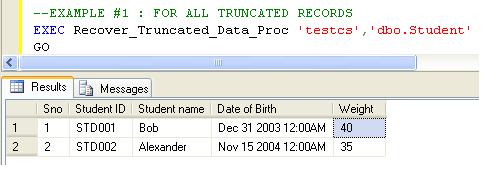
--EXAMPLE #1 : FOR ALL TRUNCATED RECORDS
EXEC Recover_Truncated_Data_Proc 'testcs','dbo.Student'
GO
--EXAMPLE #2 : FOR ANY SPECIFIC DATE RANGE
EXEC Recover_Truncated_Data_Proc  'testcs','dbo.Student','2000/01/01','2012/04/08'
--It will give you the result of all Truncated records.

Explanation

Let’s go through it step by step. The process requires few easy steps:

Step-1:

The first step is to pick the truncated records using sys.fn_dblog(SQL Log)..Given below is the sample query.

SELECT LTRIM(RTRIM(Replace([Description],'Deallocated',''))) AS [PAGE ID]
,[Slot ID],[AllocUnitId]
FROM    sys.fn_dblog(NULL, NULL)
WHERE
AllocUnitId IN
(Select [Allocation_unit_id] from sys.allocation_units allocunits
INNER JOIN sys.partitions partitions ON (allocunits.type IN (1, 3)
AND partitions.hobt_id = allocunits.container_id) OR (allocunits.type = 2
AND partitions.partition_id = allocunits.container_id)
Where object_id=object_ID('' + 'dbo.Student' + ''))
AND Operation IN ('LOP_MODIFY_ROW') AND [Context] IN ('LCX_PFS')
AND Description Like '%Deallocated%'

Step-2:

In the above sample query, the [Page ID] contains file ID and Page ID in a merge and hex format e.g ‘0001:0000005e’, where the actual data resides after truncate.So in this step we need to separate File ID and page ID than convert it into integer and enter these values in DBCC Page to get the truncated data page.

SET @Fileid=SUBSTRING(@ConsolidatedPageID,0,CHARINDEX(':',@ConsolidatedPageID)) -- Seperate File ID from Page ID

SET @hex_pageid ='0x'+ SUBSTRING(@ConsolidatedPageID,CHARINDEX(':',@ConsolidatedPageID)+1,Len(@ConsolidatedPageID))  ---Seperate the page ID
SELECT @Pageid=Convert(INT,cast('' AS XML).value('xs:hexBinary(substring(sql:variable("@hex_pageid"),sql:column("t.pos")) )', 'varbinary(max)')) -- Convert Page ID from hex to integer
FROM (SELECT CASE substring(@hex_pageid, 1, 2) WHEN '0x' THEN 3 ELSE 0 END) AS t(pos)
INSERT INTO @temppagedata EXEC( 'DBCC PAGE(' + @DataBase_Name + ', ' + @fileid + ', ' + @pageid + ', 1) with tableresults,no_infomsgs;');
INSERT INTO @pagedata SELECT @ConsolidatedPageID,@AllocUnitID,[ParentObject],[Object],[Field] ,[Value] FROM @temppagedata

Step-3:

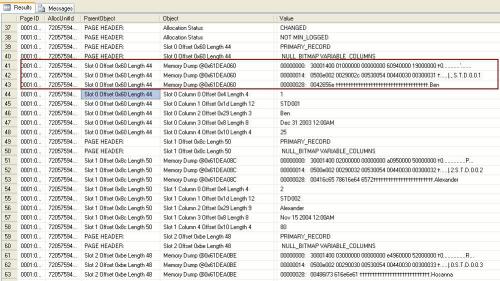
Now, we have truncated data in @pagedata table but in hex values and it contains the entire page data, most of the data we don’t need. So, we will filter our required data via this query. In this query we filter all the records containing ‘Memory Dump ‘in [object] column. But the issue is, we need the data from [value] column and in this column single row data is in multiple rows like.

00000000: 30001400 01000000 00000000 60940000 28000000 †0………..`…(…
00000014: 0500e002 0029002d 00530054 00440030 00300031 †…..).-.S.T.D.0.0.1
00000028: 00426f62 31†††††††††††††††††††††††††††††††††††.Bob1

But, we need to convert it like this in single row.
30001400010000000000000060940000280000000500e0020029002d00
530054004400300030003100426f6231


INSERT INTO @ModifiedRawData ([PAGE ID],[Slot ID],[AllocUnitId]
,[RowLog Contents 0_var])
SELECT [Page ID],Substring([ParentObject],CHARINDEX('Slot', [ParentObject])+4, (CHARINDEX('Offset', [ParentObject])-(CHARINDEX('Slot', [ParentObject])+4)) ) as [Slot ID]
,[AllocUnitId]
,(
SELECT REPLACE(STUFF((SELECT REPLACE(SUBSTRING([Value],CHARINDEX(':',[Value])+1,CHARINDEX('†',[Value])-CHARINDEX(':',[Value])),'†','')
--REPLACE(SUBSTRING([Value],CHARINDEX(':',[Value])+1,48),'†','')
FROM @pagedata C  WHERE B.[Page ID]= C.[Page ID] And Substring(B.[ParentObject],CHARINDEX('Slot', B.[ParentObject])+4, (CHARINDEX('Offset', B.[ParentObject])-(CHARINDEX('Slot', B.[ParentObject])+4)) )=Substring(C.[ParentObject],CHARINDEX('Slot', C.[ParentObject])+4, (CHARINDEX('Offset', C.[ParentObject])-(CHARINDEX('Slot', C.[ParentObject])+4)) ) And
[Object] Like '%Memory Dump%'
FOR XML PATH('') ),1,1,'') ,' ','')
) AS [Value]
From @pagedata B
Where [Object] Like '%Memory Dump%'
Group By [Page ID],[ParentObject],[AllocUnitId]
Order By [Slot ID]

Now, we have each row record in hex format, so the rest of the step we will follow the same as in How to recover deleted data from SQl server to convert it into actual data.

Appreciate your feedback on my posts. Please do comment.

We use split function in our development frequently. The purpose of this function is to split single string having delimiters (comma, semicolon etc.) to convert into multiple strings. Many developers have designed it in different ways.
Given below is the split function, developed with the help of XQuery.
Let me explain this function demonstrating simple example.

Split the @variable:

--Create this user deinfed function.
Create Function dbo.[UDF_Split]
(
@String VARCHAR(MAX),  -- Variable for string
@delimiter VARCHAR(50) -- Delimiter in the string
)
RETURNS @Table TABLE(        --Return type of the function
Splitcolumn VARCHAR(MAX)
)
BEGIN
Declare @Xml AS XML
-- Replace the delimiter to the opeing and closing tag
--to make it an xml document
SET @Xml = cast(('<A>'+replace(@String,@delimiter,'</A><A>')+'</A>') AS XML)
--Query this xml document via xquery to split rows
--and insert it into table to return.
INSERT INTO @Table SELECT A.value('.', 'varchar(max)') as [Column] FROM @Xml.nodes('A') AS FN(A)
RETURN
END
GO
-- For Example :
SELECT * FROM dbo.[UDF_Split] ('Bob,Hulda,Jacoba',',')
-- We can use this function to split table's column as well
--but the issue is, if we have 5 rows in a table
--This function will be executed 5 times.
--I have another solution to split table's column
GO

Split the Table’s Column:

CREATE TABLE [dbo].[Student](
[Student ID]   [varchar] (6) NOT NULL ,
[Student Name] [varchar](50) NOT NULL,
[Code] [varchar] (MAX))
GO
Insert into dbo.[Student] values ('STD001','Bob','E1,E2,E3')
Insert into dbo.[Student] values ('STD002','Alexander','X1,X2,X3')
Insert into dbo.[Student] values ('STD003','Hosanna','A1,A2,A3')
GO
-- Here is the sample query to split table's column.
Declare @delimiter VARCHAR(50)
Set @delimiter=','
;WITH Cte AS
(
SELECT
[Student ID],
[Student Name],
-- Replace the delimiter to the opeing and closing tag
--to make it an xml document
CAST('<M>' + REPLACE([Code], @delimiter , '</M><M>') + '</M>' AS XML) AS [Code]
FROM  [Student]
)
Select
[Student ID],
[Student Name],
--Query this xml document via xquery to split rows
Split.a.value('.', 'VARCHAR(MAX)') AS [Code]
FROM Cte
CROSS APPLY [Code].nodes('/M')Split(a)

I’d really appreciate your comments on my posts. Please feel free to comment.

The source code of how to recover the modified data is given here. But how does it work to recover modified data is explained here. Let’s go through it step by step. The process requires nine easy steps:
Before proceeding to step one, let us use the example given below for explanation :

--Example -1 --Update [Student] Set [Student Name]='Ben' Where [SNO]=1
--Operation type will be 'LOP_MODIFY_ROW'

--Example -2 --Update [Student] Set [Student Name]='Ben',[Weight]=25 Where [SNO]=1
--Operation type will be 'LOP_MODIFY_COLUMNS'

Step-1:

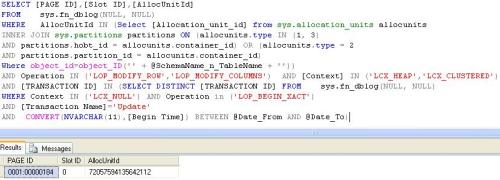
The first step is to pick the Slot ID and Page ID from the modified records using sys.fn_dblog(SQL Log). The reason behind this is to pass these slot IDs and page IDs in the DBCC Page function to get the modified records. But this modified records is available in hex format.
Note : SQL Server keeps each record of table in separate slot in a particular page number meaning if you have a slot ID and page number, you can trace the records.

But, the Page ID is a combination of File ID and Page number. So we need to separate it and then we need to pass it to DBCC Page function to filter the records.

SELECT [PAGE ID],[Slot ID],[AllocUnitId]
FROM    sys.fn_dblog(NULL, NULL)
WHERE   AllocUnitId IN (Select [Allocation_unit_id] from sys.allocation_units allocunits INNER JOIN sys.partitions partitions ON (allocunits.type IN (1, 3) AND partitions.hobt_id = allocunits.container_id) OR (allocunits.type = 2
AND partitions.partition_id = allocunits.container_id)
Where object_id=object_ID('' + @SchemaName_n_TableName + ''))
AND Operation IN ('LOP_MODIFY_ROW','LOP_MODIFY_COLUMNS')  AND [Context] IN ('LCX_HEAP','LCX_CLUSTERED')
AND [TRANSACTION ID] IN (SELECT DISTINCT [TRANSACTION ID] FROM    sys.fn_dblog(NULL, NULL)
WHERE Context IN ('LCX_NULL') AND Operation in ('LOP_BEGIN_XACT')
AND [Transaction Name]='Update'
AND  CONVERT(NVARCHAR(11),[Begin Time]) BETWEEN @Date_From AND @Date_To)

In example -1 & 2 :
Slot ID=0
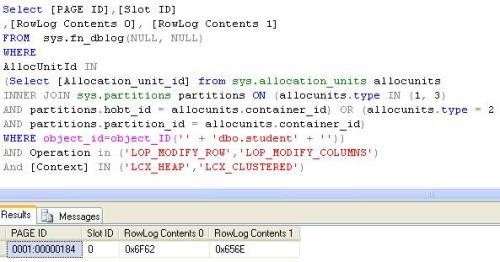
And Page ID =0001:00000184
And the break up of Page ID : 0001 is file ID And
00000184 is page No. But both of them are in Hex format. So we need to convert it into integer and then pass it to DBCC Page to filter this record.

Select Convert(int,0x0001) = 1 (In Integer)
Select Convert(int,0x00000184) = 388 (In Integer)
--We need to pass this file ID and Page ID in DBCC page function to get the page data along with
--the modified data.
DBCC Page ('test',1,388) with tableresults,no_infomsgs;
OPEN Page_Data_Cursor

FETCH NEXT FROM Page_Data_Cursor INTO @ConsolidatedPageID, @Slotid,@AllocUnitID

WHILE @@FETCH_STATUS = 0
BEGIN
DECLARE @hex_pageid AS VARCHAR(Max)
SET @Fileid=SUBSTRING(@ConsolidatedPageID,0,CHARINDEX(':',@ConsolidatedPageID))		SET @hex_pageid ='0x'+ SUBSTRING(@ConsolidatedPageID,CHARINDEX(':',@ConsolidatedPageID)+1,Len(@ConsolidatedPageID))

SELECT @Pageid=Convert(INT,cast('' AS XML).value('xs:hexBinary(substring(sql:variable("@hex_pageid"),sql:column("t.pos")) )', 'varbinary(max)'))		FROM (SELECT CASE substring(@hex_pageid, 1, 2) WHEN '0x' THEN 3 ELSE 0 END) AS t(pos)

DELETE @temppagedata
INSERT INTO @temppagedata EXEC( 'DBCC PAGE(' + @DataBase_Name + ', ' + @fileid + ', ' + @pageid + ', 3) with tableresults,no_infomsgs;');
INSERT INTO @pagedata SELECT @ConsolidatedPageID,@AllocUnitID,[ParentObject],[Object],[Field] ,[Value] FROM @temppagedata

FETCH NEXT FROM Page_Data_Cursor INTO  @ConsolidatedPageID, @Slotid,@AllocUnitID
END

Now, we have particular page data in one table along with Page ID and Alloc Unit Id. So, we can easily filter it according to the slot number to get the required data (modified data row).

Step-2:

When we filter the slot data, it is normally in multiple rows (Depends upon the amount of data), but the target is to convert it into single row for further processing.

Here is the source code to achieve this target.

DECLARE @ModifiedRawData TABLE
(
[ID] INT IDENTITY(1,1),
[PAGE ID] VARCHAR(MAX),
[Slot ID] INT,
[AllocUnitId] BIGINT,
[RowLog Contents 0_var] VARCHAR(MAX),
[RowLog Contents 0] VARBINARY(8000)
)
--This hex value is in string format
INSERT INTO @ModifiedRawData ([PAGE ID],[Slot ID],[AllocUnitId]
,[RowLog Contents 0_var])
SELECT B.[PAGE ID],A.[Slot ID],A.[AllocUnitId]
,(
SELECT REPLACE(STUFF((SELECT REPLACE(SUBSTRING([VALUE],CHARINDEX(':',[Value])+1,48),'†','')
FROM @pagedata C  WHERE B.[Page ID]= C.[Page ID] And A.[Slot ID] =LTRIM(RTRIM(SUBSTRING(C.[ParentObject],5,3))) And [Object] Like '%Memory Dump%'
FOR XML PATH('') ),1,1,'') ,' ','')
) AS [Value]

FROM sys.fn_dblog(NULL, NULL) A
INNER JOIN @pagedata B On A.[PAGE ID]=B.[PAGE ID]
AND A.[AllocUnitId]=B.[AllocUnitId]
AND A.[Slot ID] =LTRIM(RTRIM(Substring(B.[ParentObject],5,3)))
AND B.[Object] Like '%Memory Dump%'
WHERE A.AllocUnitId IN
(Select [Allocation_unit_id] from sys.allocation_units allocunits
INNER JOIN sys.partitions partitions ON (allocunits.type IN (1, 3)
AND partitions.hobt_id = allocunits.container_id) OR (allocunits.type = 2
AND partitions.partition_id = allocunits.container_id)
Where object_id=object_ID('' + @SchemaName_n_TableName + ''))
AND Operation in ('LOP_MODIFY_ROW','LOP_MODIFY_COLUMNS') AND [Context] IN ('LCX_HEAP','LCX_CLUSTERED')
/*Use this sub query to filter the date*/

AND [TRANSACTION ID] IN (Select DISTINCT [TRANSACTION ID] FROM sys.fn_dblog(NULL, NULL)
Where Context IN ('LCX_NULL') AND Operation IN ('LOP_BEGIN_XACT')
AND [Transaction Name]='Update'
AND  CONVERT(NVARCHAR(11),[Begin Time]) BETWEEN @Date_From AND @Date_To)

/****************************************/
GROUP BY B.[PAGE ID],A.[Slot ID],A.[AllocUnitId]--,[Transaction ID]
ORDER BY [Slot ID]
--But the issue is, this modified data is in string format, we need to convert it into hex format.

UPDATE @ModifiedRawData  SET [RowLog Contents 0] = cast('' AS XML).value('xs:hexBinary(substring(sql:column("[RowLog Contents 0_var]"), 0) )', 'varbinary(max)')
FROM @ModifiedRawData

Step-3:

The next step is to get the modified records from sql server. By using the standard SQL Server function fn_blog. We need only the selected modified records from the transaction log. So we included three filters in select statement(Context, Operation & AllocUnitId).

  • Context (‘LCX_CLUSTERED’and ‘LCX_HEAP’)
  • Operation (‘LOP_MODIFY_ROW’,’LOP_MODIFY_COLUMNS’)
  • AllocUnitId

Here is the code snippet:

Select [PAGE ID],[Slot ID],[AllocUnitId],[Transaction ID],[RowLog Contents 0], [RowLog Contents 1],[RowLog Contents 3],[RowLog Contents 4]
,[Log Record]
FROM    sys.fn_dblog(NULL, NULL)
WHERE    AllocUnitId IN
(Select [Allocation_unit_id] from sys.allocation_units allocunits
INNER JOIN sys.partitions partitions ON (allocunits.type IN (1, 3)
AND partitions.hobt_id = allocunits.container_id) OR (allocunits.type = 2
AND partitions.partition_id = allocunits.container_id)
Where object_id=object_ID('' + 'dbo.student' + ''))
AND Operation in ('LOP_MODIFY_ROW','LOP_MODIFY_COLUMNS') And [Context] IN ('LCX_HEAP','LCX_CLUSTERED')

AllocUnitId : Allocation Unit ID of the table name.

We filtered two types of Operation type from sql log. Given below are the details, Why SQL server create these operation types in Log and what is the difference ?:
1-LOP_MODIFY_ROW
If there is an update that might impact in variable length column values (offset) then the type will be LOP_MODIFY_ROW.
For example -1:
Update [Student] Set [Student Name]=’Ben Where [SNO]=1

2-LOP_MODIFY_COLUMNS
If there is an update that might not impact in variable length column values (offset) and the update should impact in both fixed and variable length columns then the type will be LOP_MODIFY_COLUMNS.

For example -2:
Update [Student] Set [Student Name]=’Ben’ , [Weight]=25 Where [SNO]=1

Step-4:

Before proceeding further, we need to understand that how SQL Server keeps modified records in logs.
In both operation type cases, SQL Server keeps the modified data in the form of data chunks (only the portion that is modified and its previous state). But the question is where it is located ?

1-‘LOP_MODIFY_ROW’
If the operation type is ‘LOP_MODIFY_ROW’ then we need to select [RowLog Contents 0] (contains old data (before modification)) And [RowLog Contents 1] (contains Modified data) from the sys.fn_dblog function. But these data chunks are in hex format.

For example -1:

Select [PAGE ID],[Slot ID]
,[RowLog Contents 0], [RowLog Contents 1]
FROM    sys.fn_dblog(NULL, NULL)
WHERE AllocUnitId IN
(Select [Allocation_unit_id] from sys.allocation_units allocunits
INNER JOIN sys.partitions partitions ON (allocunits.type IN (1, 3)
AND partitions.hobt_id = allocunits.container_id) OR (allocunits.type = 2
AND partitions.partition_id = allocunits.container_id)
Where object_id=object_ID('' + 'dbo.student' + ''))
AND Operation in ('LOP_MODIFY_ROW') And [Context] IN ('LCX_HEAP','LCX_CLUSTERED')

[RowLog Contents 0]= 0x6F62 --Select Convert (varchar(max),0x6F62)
[RowLog Contents 1]= 0x656E --Select Convert (varchar(max),0x656E)

2-‘LOP_MODIFY_COLUMNS’
If the operation type is ‘LOP_MODIFY_COLUMNS’ then actual data (before modification) And modified data is available in [Log Record] column in the sys.fn_dblog function. But this data in merge format and in one hex data chunk.
For example -2:

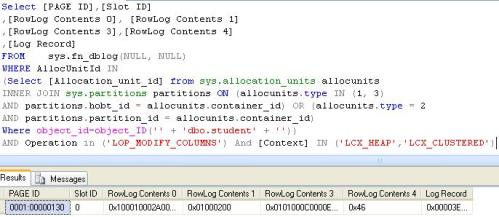
Select [PAGE ID],[Slot ID]
,[RowLog Contents 0], [RowLog Contents 1]
,[RowLog Contents 3],[RowLog Contents 4]
,[Log Record]
FROM    sys.fn_dblog(NULL, NULL)
WHERE AllocUnitId IN
(Select [Allocation_unit_id] from sys.allocation_units allocunits
INNER JOIN sys.partitions partitions ON (allocunits.type IN (1, 3)
AND partitions.hobt_id = allocunits.container_id) OR (allocunits.type = 2
AND partitions.partition_id = allocunits.container_id)
Where object_id=object_ID('' + 'dbo.student' + ''))
AND Operation in ('LOP_MODIFY_COLUMNS') And [Context] IN ('LCX_HEAP','LCX_CLUSTERED')

But, if the data is in the column [Log Record] then why we need to select other columns, basically other columns info will help us to select and separate the merge data chunk into modified and actual data from [log record] column.

Step-5:

In case of operation type ‘LOP_MODIFY_ROW’, It is very simple to recover. Now we have the modified row (we prepare it in step 2) in hex format and modified and actual data chunks. Given below is the Modified Data is in Hex format.
0x30001400010000000000000060940000460000000500E0020029002C0
053005400440030003000310042656E
And data chunks
Before Modification data : 0x6F62
After Modification data : 0x656E
Now we need to replace the matching portion of the data from modified to actual one to recover actual data.
So, after replacement we will get the old (actual values before modification) values.
0x30001400010000000000000060940000460000000500E0020029002C0
0530054004400300030003100426F62

INSERT INTO @ModifiedRawData ([PAGE ID],[Slot ID],[AllocUnitId],[RowLog Contents 0_var])
SELECT TOP 1  @ConsolidatedPageID AS [PAGE ID],@Slotid AS [Slot ID],@AllocUnitID AS [AllocUnitId],REPLACE ([RowLog Contents 0_var],CAST('' AS XML).value('xs:hexBinary(sql:variable("@RowLogContents1") )', 'varchar(max)'),cast('' AS XML).value('xs:hexBinary(sql:variable("@RowLogContents0") )', 'varchar(max)')) AS [RowLog Contents 0_var]
FROM  @ModifiedRawData WHERE [PAGE ID]=@ConsolidatedPageID And [Slot ID]=@Slotid And [AllocUnitId]=@AllocUnitID ORDER BY [ID] DESC

UPDATE @ModifiedRawData  SET [RowLog Contents 0] = cast('' AS XML).value('xs:hexBinary(substring(sql:column("[RowLog Contents 0_var]"), 0) )', 'varbinary(max)')
FROM @ModifiedRawData

Finally, we recovered the data. Now we need to convert this hex values into their original data types.(readable format).
But, still the recovery is not finished because, we have operation type ‘LOP_MODIFY_COLUMNS’ to discuss.

Step-6:

If operation type is ‘LOP_MODIFY_COLUMNS’, we need to follow a different mechanism to recover the modified data.

     Step-6.1:

As we discussed, the data for this operation type is in the [Log record] but in merge format, so we need to get the [log record] field data. Here is the query.

Select [PAGE ID],[Slot ID],[AllocUnitId],[Transaction ID],[RowLog Contents 0], [RowLog Contents 1],[RowLog Contents 3],[RowLog Contents 4]
,Substring ([Log Record],[Log Record Fixed Length],([Log Record Length]+1)-([Log Record Fixed Length])) as [Log Record]
,Operation
FROM    sys.fn_dblog(NULL, NULL)
WHERE    --AllocUnitName =@SchemaName_n_TableName --'dbo.STUDENT'
AllocUnitId IN
(Select [Allocation_unit_id] from sys.allocation_units allocunits
INNER JOIN sys.partitions partitions ON (allocunits.type IN (1, 3)
AND partitions.hobt_id = allocunits.container_id) OR (allocunits.type = 2
AND partitions.partition_id = allocunits.container_id)
Where object_id=object_ID('' + @SchemaName_n_TableName + ''))
AND Operation in ('LOP_MODIFY_ROW','LOP_MODIFY_COLUMNS') And [Context] IN ('LCX_HEAP','LCX_CLUSTERED')
/*Use this subquery to filter the date*/

AND [TRANSACTION ID] IN (Select DISTINCT [TRANSACTION ID] FROM    sys.fn_dblog(NULL, NULL)
WHERE Context IN ('LCX_NULL') AND Operation IN ('LOP_BEGIN_XACT')
AND [Transaction Name]='Update'
AND  CONVERT(NVARCHAR(11),[Begin Time]) BETWEEN @Date_From AND @Date_To)

     Step-6.2:

We reduced [log record] field data, because we ignored till the length of the fixed lenght data and pick the rest of the values. But still we don’t have our required data. On this log data we need to search [RowLog Contents 3] column data in Log record because exactly after [RowLog Contents 3] column data our required data is there.

SET @RowLogData_Var = SUBSTRING(@LogRecord_Var, CHARINDEX(@RowLogContents3_Var,@LogRecord_Var) +LEN(@RowLogContents3_Var) ,LEN(@LogRecord_Var))

SELECT @RowLogData_Hex=CAST('' AS XML).value('xs:hexBinary( substring(sql:variable("@RowLogData_Var"),0) )', 'varbinary(max)') FROM (SELECT CASE SUBSTRING(@RowLogData_Var, 1, 2) WHEN '0x' THEN 3 ELSE 0 END) AS t(pos)

Example -2 :
Log record =0x00080008000400000014000100010002000200100010002A002A0001000
2000101000C00002364944E00000102000402030004
464A61631962616D6F62000C656E2364
[RowLog Contents3]= 0x0101000C00002364944E00000102000402030004
Our required Data : 0x464A61631962616D6F62000C656E2364
Structure of our required data is : Actual Fixed length data chunk + Modified Fixed length data chunks + Actual Variable length data chunk + Modified Variable length data chunks
Now, we have our required data and we also know the structure of the required data but still we do not know to separate the chunks.

     Step-6.3:

The required data is in @RowLogData_Hex variable. The target is to separate both fixed data and variable data with respect to actual and modified data chunks.
To achieve this, we need to know the length and start position of the chunks to separate the data.
In the [RowLog Contents 1] field, we have the length of fixed length and variable length data.

--For Fixed Length Data Chunks (The length of actual and modified data chunks will be same)
SET @FixedLength_Loc= CONVERT(INT,SUBSTRING(@RowLogContents1,1,1))
Select  CONVERT(INT,SUBSTRING(0x01000200,1,1))
--@FixedLength_Loc=1 Means Fixed Length is 1.

-- For Variable Length Data Chunks (The length of actual and modified data chunks will be same)
SET @VariableLength_Loc =CONVERT(INT,SUBSTRING(@RowLogContents1,3,1))
Select CONVERT(INT,SUBSTRING(0x01000200,3,1))
--@VariableLength_Loc=2 Means variable Length is 2.

--In the [RowLog Contents 0] field, we have the start position of fixed length & variable length data --modification.
-- These fixed length and variable length start positions, we will use at the time of replacement.
SET @FixedLength_Offset= CONVERT(BINARY(2),REVERSE(CONVERT(BINARY(4),(@RowLogContents0))))--)
Select CONVERT(int,CONVERT(BINARY(2),REVERSE(CONVERT(BINARY(4),(0x100010002A002A00)))))
--@FixedLength_Offset =16 Means Start Position of modification in Fixed Length is 16.

SET @VariableLength_Offset=CONVERT(int,CONVERT(BINARY(2),REVERSE(@RowLogContents0)))
Select CONVERT(int,CONVERT(BINARY(2),REVERSE(0x100010002A002A00)))
--@VariableLength_Offset42 Means Start Position of modification in variable Length is 42.

     Step-6.4:

Now, we have the length and the start position so we can easily get the actual and modified data chunks

-- Actual Fixed length data chunk
SET @FixedOldValues = SUBSTRING(@RowLogData_Hex,1,@FixedLength_Loc)
Select Substring(0x464A61631962616D6F62000C656E2364,1,1)= 0x46

--One more thing we need to find out that what is the reminder in the  @FixedOldValues because if there --is remaindar we need to add it to find the modified chunk.
SET @FixedLengthIncrease = (CASE WHEN (Len(@FixedOldValues)%4)=0 THEN 1 ELSE (4-(LEN(@FixedOldValues)%4))+1  END)

@FixedLengthIncrease=4

--Modified Fixed length data chunks
SET @FixedNewValues =SUBSTRING(@RowLogData_Hex,@FixedLength_Loc+@FixedLengthIncrease,@FixedLength_Loc)
Select SUBSTRING(0x464A61631962616D6F62000C656E2364,1+4,1) =0x19

-- Actual Variable length data chunk
SET @VariableOldValues =SUBSTRING(@RowLogData_Hex,@FixedLength_Loc+@FixedLengthIncrease+@FixedLength_Loc+(@FixedLengthIncrease-1),@VariableLength_Loc)
Select SUBSTRING(0x464A61631962616D6F62000C656E2364,1+4+1+(4-1),2)=0x6F62

--Modified Fixed length data chunks
--Same for variable increase.
SET @VariableLengthIncrease =  (CASE WHEN (LEN(@VariableOldValues)%4)=0 THEN 1 ELSE (4-(Len(@VariableOldValues)%4))  END)

Select SUBSTRING(SUBSTRING(0x464A61631962616D6F62000C656E2364,1+4+1+(4-1)+2+2,2+1),1,LEN(0x6F62))
=0x656E

     Step-6.5:

In step 2, we have the modified data
0x30001400010000000000000060940000190000000500E0020029002C0053005400440030003000310042656E and in the step 6.5 we received the chunks of actual and modifed data. Now we need to do simple replacement as per the start positions we found from [RowLog Contents 0] field.

SELECT TOP 1  @ConsolidatedPageID AS [PAGE ID],@Slotid AS [Slot ID],@AllocUnitID AS [AllocUnitId],NULL
,SUBSTRING([RowLog Contents 0] ,0,@FixedLength_Offset+1)
+ CAST(REPLACE(SUBSTRING([RowLog Contents 0],@FixedLength_Offset+1,(@TotalFixedLengthData+4)-@FixedLength_Offset),@FixedNewValues, @FixedOldValues) AS VARBINARY(max))
+ SUBSTRING([RowLog Contents 0],@TotalFixedLengthData+5,(@VariableLength_Offset+1)-(@TotalFixedLengthData+5))
+ CAST(REPLACE(SUBSTRING([RowLog Contents 0],@VariableLength_Offset+1,Len(@VariableNewValues))
, @VariableNewValues
, @VariableOldValues) AS VARBINARY)+ SUBSTRING([RowLog Contents 0],@VariableLength_Offset+1+Len(@VariableNewValues),Len([RowLog Contents 0])-(@VariableLength_Offset+LEN(@VariableNewValues)))

So it will be like Modified Data : 0x30001400010000000000000060940000190000000500E002002900
2C0053005400440030003000310042656E
Actual Data : 0x30001400010000000000000060940000460000000500E002002900
2C00530054004400300030003100426F62

Step-7:

Now, we have both actual and modified data in hex values, we need to follow the same steps followed under ‘how to recover deleted records’ to convert it into readable data format.

Step-8:

We have the data in actual format, Now we can identify which column has been updated and which is same. On the basis we can create an update statement that can help you to recover the modified data.

;With CTE AS (SELECT(CASE
WHEN system_type_id In (167,175,189) THEN QUOTENAME([Name]) + '=' + ISNULL(+ '''' + A.[FieldValue]+ '''','NULL')+ ' ,'+' '
WHEN system_type_id In (231,239) THEN  QUOTENAME([Name]) + '='  + ISNULL(+ 'N''' +A.[FieldValue]+ '''','NULL')+ ' ,'+''
WHEN system_type_id In (58,61,36) THEN QUOTENAME([Name]) + '='  + ISNULL(+  ''''+A.[FieldValue]+ '''','NULL') + '  ,'+' '
WHEN system_type_id In (48,52,56,59,60,62,104,106,108,122,127) THEN QUOTENAME([Name]) + '='  + ISNULL(A.[FieldValue],'NULL')+ ' ,'+' '
END) as [Field]
,A.[Slot ID]
,A.[Transaction ID] as [Transaction ID]
,'D' AS [Type]
,[A].Rowlogcontents
FROM #temp_Data AS [A]
INNER JOIN #temp_Data AS [B] ON [A].[FieldName]=[B].[FieldName]
AND [A].[Slot ID]=[B].[Slot ID]
AND [B].[Transaction ID]=  (SELECT Min(Cast([Transaction ID] as int)) as [Transaction ID]  FROM [B] AS [C]
WHERE [A].[Slot ID]=[C].[Slot ID]
GROUP BY [Slot ID])
INNER JOIN sys.columns [D] On  [object_id]=object_id('' + @SchemaName_n_TableName + '')
AND A.[Fieldname]=D.[name]
WHERE ISNULL([A].[FieldValue],'')<>ISNULL([B].[FieldValue],'')

UNION ALL

SELECT(CASE
WHEN system_type_id In (167,175,189) THEN QUOTENAME([Name]) + '=' + ISNULL(+ '''' + A.[FieldValue]+ '''','NULL')+ ' AND '+''
WHEN system_type_id In (231,239) THEN  QUOTENAME([Name]) + '='+ ISNULL(+ 'N''' +A.[FieldValue]+ '''','NULL')+ ' AND '+''
WHEN system_type_id In (58,61,36) THEN QUOTENAME([Name]) + '=' + ISNULL(+  ''''+A.[FieldValue]+ '''','NULL') + ' AND '+''
WHEN system_type_id In (48,52,56,59,60,62,104,106,108,122,127) THEN QUOTENAME([Name]) + '='  + ISNULL(A.[FieldValue],'NULL') + ' AND '+''
END) AS [Field]
,A.[Slot ID]
,A.[Transaction ID] AS [Transaction ID]
,'S' AS [Type]
,[A].Rowlogcontents
FROM #temp_Data AS [A]
INNER JOIN #temp_Data AS [B] ON [A].[FieldName]=[B].[FieldName]
AND [A].[Slot ID]=[B].[Slot ID]
AND [B].[Transaction ID]=  (SELECT Min(Cast([Transaction ID] as int)) as [Transaction ID] FROM [B] AS [C]
WHERE [A].[Slot ID]=[C].[Slot ID]
GROUP BY [Slot ID])
INNER JOIN sys.columns [D] ON  [object_id]=object_id('' + @SchemaName_n_TableName + '')
AND A.[Fieldname]=D.[name]
WHERE ISNULL([A].[FieldValue],'')=ISNULL([B].[FieldValue],'')
AND A.[Transaction ID] NOT IN (SELECT Min(Cast([Transaction ID] as int)) as [Transaction ID] FROM [B] AS [C]
WHERE [A].[Slot ID]=[C].[Slot ID]
GROUP BY [Slot ID])
)

,CTEUpdateQuery AS (SELECT 'UPDATE ' +  @SchemaName_n_TableName +  ' SET ' + LEFT(
STUFF((SELECT ' ' + ISNULL([Field],'')+ ' ' FROM CTE B
WHERE A.[Slot ID]=B.[Slot ID] AND A.[Transaction ID]=B.[Transaction ID] And B.[Type]='D' FOR XML PATH('') ),1,1,''),

LEN(STUFF((SELECT ' ' +ISNULL([Field],'')+ ' ' FROM CTE B
WHERE A.[Slot ID]=B.[Slot ID] AND A.[Transaction ID]=B.[Transaction ID] And B.[Type]='D' FOR XML PATH('') ),1,1,'') )-3)

+ '  WHERE  ' +

LEFT(STUFF((SELECT ' ' +ISNULL([Field],'')+ ' ' FROM CTE C
WHERE A.[Slot ID]=C.[Slot ID] AND A.[Transaction ID]=C.[Transaction ID] And C.[Type]='S' FOR XML PATH('') ),1,1,'') ,

LEN(STUFF((SELECT ' ' +ISNULL([Field],'')+ ' ' FROM CTE C
WHERE A.[Slot ID]=C.[Slot ID] AND A.[Transaction ID]=C.[Transaction ID] And C.[Type]='S' FOR XML PATH('') ),1,1,''))-5)
AS [Update Statement],
[Slot ID]
,[Transaction ID]
,Rowlogcontents
FROM CTE A
GROUP BY [Slot ID]
,[Transaction ID]
,Rowlogcontents )

INSERT INTO #temp_Data SELECT 'UPDATE STATEMENT',[Update Statement],[Rowlogcontents],[Transaction ID],[Slot ID] FROM CTEUpdateQuery

Your observations on my posts are very much appreciated. Therefore please do comment.

In my previous post “How to recover deleted records from SQL Server”, I received requests to “develop a mechanism that can recover the modified records from SQL Server”

Now, it is very easy to recover modified data from your SQL server 2005 or above.(Note: This script can recover following data types & compatible with CS collation).

  • tinyint
  • smallint
  • int
  • bigint
  • bit
  • char
  • varchar
  • nchar
  • nvarchar
  • datetime
  • smalldatetime
  • money
  • smallmoney
  • decimal
  • numeric
  • real
  • float
  • binary
  • varbinary
  • uniqueidentifier

Let me explain this issue demonstrating simple example.

--Create Table
CREATE TABLE [dbo].[Student](
[Sno] [int] NOT NULL,
[Student ID] nvarchar(6) Not NULL ,
[Student name] [varchar](50) NOT NULL,
[Date of Birth]  datetime not null,
[Weight] [int] NULL)
--Inserting data into table
Insert into dbo.[Student] values (1,'STD001','Bob','2003-12-31',40)
Insert into dbo.[Student] values (2,'STD002','Alexander','2004-11-15',35)
--Check the existence of the data
Select * from dbo.[Student]

--By mistake if all records are updated instead of one record
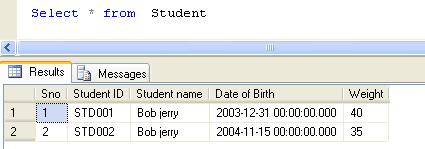
Update [Student] Set [Student Name]='Bob jerry' --Where [SNO]=1 forget to use where clause
--Verify the data has been modified
Select * from dbo.[Student]
Now, you need to create this procedure to recover your modified data

Create PROCEDURE Recover_Modified_Data_Proc
@Database_Name NVARCHAR(MAX),
@SchemaName_n_TableName NVARCHAR(MAX),
@Date_From datetime='1900/01/01',
@Date_To datetime ='9999/12/31'
AS
DECLARE @parms nvarchar(1024)
DECLARE @Fileid INT
DECLARE @Pageid INT
DECLARE @Slotid INT
DECLARE @RowLogContents0 VARBINARY(8000)
DECLARE @RowLogContents1 VARBINARY(8000)
DECLARE @RowLogContents3 VARBINARY(8000)
DECLARE @RowLogContents3_Var VARCHAR(MAX)

DECLARE @RowLogContents4 VARBINARY(8000)
DECLARE @LogRecord VARBINARY(8000)
DECLARE @LogRecord_Var VARCHAR(MAX)

DECLARE @ConsolidatedPageID VARCHAR(MAX)
Declare @AllocUnitID as bigint
Declare @TransactionID as VARCHAR(MAX)
Declare @Operation as VARCHAR(MAX)
Declare @DatabaseCollation VARCHAR(MAX)

/*  Pick The actual data
*/
declare @temppagedata table
(
[ParentObject] sysname,
[Object] sysname,
[Field] sysname,
[Value] sysname)

declare @pagedata table
(
[Page ID] sysname,
[AllocUnitId] bigint,
[ParentObject] sysname,
[Object] sysname,
[Field] sysname,
[Value] sysname)

DECLARE Page_Data_Cursor CURSOR FOR
/*We need to filter LOP_MODIFY_ROW,LOP_MODIFY_COLUMNS from log for modified records & Get its Slot No, Page ID & AllocUnit ID*/
SELECT [PAGE ID],[Slot ID],[AllocUnitId]
FROM    sys.fn_dblog(NULL, NULL)
WHERE
AllocUnitId IN
(Select [Allocation_unit_id] from sys.allocation_units allocunits
INNER JOIN sys.partitions partitions ON (allocunits.type IN (1, 3)
AND partitions.hobt_id = allocunits.container_id) OR (allocunits.type = 2
AND partitions.partition_id = allocunits.container_id)
Where object_id=object_ID('' + @SchemaName_n_TableName + ''))
AND Operation IN ('LOP_MODIFY_ROW','LOP_MODIFY_COLUMNS')  AND [Context] IN ('LCX_HEAP','LCX_CLUSTERED')
/*Use this subquery to filter the date*/

AND [TRANSACTION ID] IN (SELECT DISTINCT [TRANSACTION ID] FROM    sys.fn_dblog(NULL, NULL)
WHERE Context IN ('LCX_NULL') AND Operation in ('LOP_BEGIN_XACT')
AND [Transaction Name]='UPDATE'
AND  CONVERT(NVARCHAR(11),[Begin Time]) BETWEEN @Date_From AND @Date_To)

/****************************************/

GROUP BY [PAGE ID],[Slot ID],[AllocUnitId]
ORDER BY [Slot ID]

OPEN Page_Data_Cursor

FETCH NEXT FROM Page_Data_Cursor INTO @ConsolidatedPageID, @Slotid,@AllocUnitID

WHILE @@FETCH_STATUS = 0
BEGIN
DECLARE @hex_pageid AS VARCHAR(Max)
/*Page ID contains File Number and page number It looks like 0001:00000130.
In this example 0001 is file Number &  00000130 is Page Number & These numbers are in Hex format*/
SET @Fileid=SUBSTRING(@ConsolidatedPageID,0,CHARINDEX(':',@ConsolidatedPageID)) -- Seperate File ID from Page ID
SET @hex_pageid ='0x'+ SUBSTRING(@ConsolidatedPageID,CHARINDEX(':',@ConsolidatedPageID)+1,Len(@ConsolidatedPageID))  ---Seperate the page ID

SELECT @Pageid=Convert(INT,cast('' AS XML).value('xs:hexBinary(substring(sql:variable("@hex_pageid"),sql:column("t.pos")) )', 'varbinary(max)')) -- Convert Page ID from hex to integer
FROM (SELECT CASE substring(@hex_pageid, 1, 2) WHEN '0x' THEN 3 ELSE 0 END) AS t(pos)

DELETE @temppagedata
-- Now we need to get the actual data (After modification) from the page
INSERT INTO @temppagedata EXEC( 'DBCC PAGE(' + @DataBase_Name + ', ' + @fileid + ', ' + @pageid + ', 3) with tableresults,no_infomsgs;');
-- Add Page Number and allocUnit ID in data to identity which one page it belongs to.
INSERT INTO @pagedata SELECT @ConsolidatedPageID,@AllocUnitID,[ParentObject],[Object],[Field] ,[Value] FROM @temppagedata

FETCH NEXT FROM Page_Data_Cursor INTO  @ConsolidatedPageID, @Slotid,@AllocUnitID
END

CLOSE Page_Data_Cursor
DEALLOCATE Page_Data_Cursor

DECLARE @Newhexstring VARCHAR(MAX);

DECLARE @ModifiedRawData TABLE
(
[ID] INT IDENTITY(1,1),
[PAGE ID] VARCHAR(MAX),
[Slot ID] INT,
[AllocUnitId] BIGINT,
[RowLog Contents 0_var] VARCHAR(MAX),
[RowLog Contents 0] VARBINARY(8000)
)
--The modified data is in multiple rows in the page, so we need to convert it into one row as a single hex value.
--This hex value is in string format
INSERT INTO @ModifiedRawData ([PAGE ID],[Slot ID],[AllocUnitId]
,[RowLog Contents 0_var])
SELECT B.[PAGE ID],A.[Slot ID],A.[AllocUnitId]
,(
SELECT REPLACE(STUFF((SELECT REPLACE(SUBSTRING([VALUE],CHARINDEX(':',[Value])+1,48),'†','')
FROM @pagedata C  WHERE B.[Page ID]= C.[Page ID] And A.[Slot ID] =LTRIM(RTRIM(SUBSTRING(C.[ParentObject],5,3))) And [Object] Like '%Memory Dump%'
Group By [Value] FOR XML PATH('') ),1,1,'') ,' ','')
) AS [Value]

FROM sys.fn_dblog(NULL, NULL) A
INNER JOIN @pagedata B On A.[PAGE ID]=B.[PAGE ID]
AND A.[AllocUnitId]=B.[AllocUnitId]
AND A.[Slot ID] =LTRIM(RTRIM(Substring(B.[ParentObject],5,3)))
AND B.[Object] Like '%Memory Dump%'
WHERE A.AllocUnitId IN
(Select [Allocation_unit_id] from sys.allocation_units allocunits
INNER JOIN sys.partitions partitions ON (allocunits.type IN (1, 3)
AND partitions.hobt_id = allocunits.container_id) OR (allocunits.type = 2
AND partitions.partition_id = allocunits.container_id)
Where object_id=object_ID('' + @SchemaName_n_TableName + ''))
AND Operation in ('LOP_MODIFY_ROW','LOP_MODIFY_COLUMNS') AND [Context] IN ('LCX_HEAP','LCX_CLUSTERED')
/*Use this subquery to filter the date*/

AND [TRANSACTION ID] IN (Select DISTINCT [TRANSACTION ID] FROM sys.fn_dblog(NULL, NULL)
Where Context IN ('LCX_NULL') AND Operation IN ('LOP_BEGIN_XACT')
AND [Transaction Name]='UPDATE'
AND  CONVERT(NVARCHAR(11),[Begin Time]) BETWEEN @Date_From AND @Date_To)

/****************************************/
GROUP BY B.[PAGE ID],A.[Slot ID],A.[AllocUnitId]--,[Transaction ID]
ORDER BY [Slot ID]

-- Convert the hex value data in string, convert it into Hex value as well.
UPDATE @ModifiedRawData  SET [RowLog Contents 0] = cast('' AS XML).value('xs:hexBinary(substring(sql:column("[RowLog Contents 0_var]"), 0) )', 'varbinary(max)')
FROM @ModifiedRawData

---Now we have modifed data plus its slot ID , page ID and allocunit as well.
--After that we need to get the old values before modfication, these datas are in chunks.
DECLARE Page_Data_Cursor CURSOR FOR

Select [PAGE ID],[Slot ID],[AllocUnitId],[Transaction ID],[RowLog Contents 0], [RowLog Contents 1],[RowLog Contents 3],[RowLog Contents 4]
,Substring ([Log Record],[Log Record Fixed Length],([Log Record Length]+1)-([Log Record Fixed Length])) as [Log Record]
,Operation
FROM    sys.fn_dblog(NULL, NULL)
WHERE   AllocUnitId IN
(Select [Allocation_unit_id] from sys.allocation_units allocunits
INNER JOIN sys.partitions partitions ON (allocunits.type IN (1, 3)
AND partitions.hobt_id = allocunits.container_id) OR (allocunits.type = 2
AND partitions.partition_id = allocunits.container_id)
Where object_id=object_ID('' + @SchemaName_n_TableName + ''))
AND Operation in ('LOP_MODIFY_ROW','LOP_MODIFY_COLUMNS') And [Context] IN ('LCX_HEAP','LCX_CLUSTERED')
/*Use this sub query to filter the date*/

AND [TRANSACTION ID] IN (Select DISTINCT [TRANSACTION ID] FROM    sys.fn_dblog(NULL, NULL)
WHERE Context IN ('LCX_NULL') AND Operation IN ('LOP_BEGIN_XACT')
AND [Transaction Name]='UPDATE'
AND  CONVERT(NVARCHAR(11),[Begin Time]) BETWEEN @Date_From AND @Date_To)

/****************************************/
Order By [Slot ID],[Transaction ID] DESC

OPEN Page_Data_Cursor

FETCH NEXT FROM Page_Data_Cursor INTO @ConsolidatedPageID, @Slotid,@AllocUnitID,@TransactionID,@RowLogContents0,@RowLogContents1,@RowLogContents3,@RowLogContents4,@LogRecord,@Operation
WHILE @@FETCH_STATUS = 0
BEGIN
IF @Operation ='LOP_MODIFY_ROW'
BEGIN
/* If it is @Operation Type is 'LOP_MODIFY_ROW' then it is very simple to recover the modified data. The old data is in [RowLog Contents 0] Field and modified data is in [RowLog Contents 1] Field. Simply replace it with the modified data and get the old data.
*/
INSERT INTO @ModifiedRawData ([PAGE ID],[Slot ID],[AllocUnitId],[RowLog Contents 0_var])
SELECT TOP 1  @ConsolidatedPageID AS [PAGE ID],@Slotid AS [Slot ID],@AllocUnitID AS [AllocUnitId]
,REPLACE (UPPER([RowLog Contents 0_var]),UPPER(CAST('' AS XML).value('xs:hexBinary(sql:variable("@RowLogContents1") )', 'varchar(max)')),UPPER(cast('' AS XML).value('xs:hexBinary(sql:variable("@RowLogContents0") )', 'varchar(max)'))) AS [RowLog Contents 0_var]
FROM  @ModifiedRawData WHERE [PAGE ID]=@ConsolidatedPageID And [Slot ID]=@Slotid And [AllocUnitId]=@AllocUnitID ORDER BY [ID] DESC

--- Convert the old data which is in string format to hex format.
UPDATE @ModifiedRawData  SET [RowLog Contents 0] = cast('' AS XML).value('xs:hexBinary(substring(sql:column("[RowLog Contents 0_var]"), 0) )', 'varbinary(max)')
FROM @ModifiedRawData Where [Slot ID]=@SlotID

END
IF @Operation ='LOP_MODIFY_COLUMNS'
BEGIN

/* If it is @Operation Type is 'LOP_MODIFY_ROW' then we need to follow a different procedure to recover modified
.Because this time the data is also in chunks but merge with the data log.
*/
--First, we need to get the [RowLog Contents 3] Because in [Log Record] field the modified data is available after the [RowLog Contents 3] data.
SET @RowLogContents3_Var=cast('' AS XML).value('xs:hexBinary(sql:variable("@RowLogContents3") )', 'varchar(max)')
SET @LogRecord_Var =cast('' AS XML).value('xs:hexBinary(sql:variable("@LogRecord"))', 'varchar(max)')

DECLARE @RowLogData_Var VARCHAR(Max)
DECLARE @RowLogData_Hex VARBINARY(Max)
---First get the modifed data chunks in string format
SET @RowLogData_Var = SUBSTRING(@LogRecord_Var, CHARINDEX(@RowLogContents3_Var,@LogRecord_Var) +LEN(@RowLogContents3_Var) ,LEN(@LogRecord_Var))
--Then convert it into the hex values.
SELECT @RowLogData_Hex=CAST('' AS XML).value('xs:hexBinary( substring(sql:variable("@RowLogData_Var"),0) )', 'varbinary(max)')
FROM (SELECT CASE SUBSTRING(@RowLogData_Var, 1, 2) WHEN '0x' THEN 3 ELSE 0 END) AS t(pos)
DECLARE @TotalFixedLengthData INT
DECLARE @FixedLength_Offset INT
DECLARE @VariableLength_Offset INT
DECLARE @VariableLength_Offset_Start INT
DECLARE @VariableLengthIncrease INT
DECLARE @FixedLengthIncrease INT
DECLARE @OldFixedLengthStartPosition INT
DECLARE @FixedLength_Loc INT
DECLARE @VariableLength_Loc INT
DECLARE @FixedOldValues VARBINARY(MAX)
DECLARE @FixedNewValues VARBINARY(MAX)
DECLARE @VariableOldValues VARBINARY(MAX)
DECLARE @VariableNewValues VARBINARY(MAX)

-- Before recovering the modfied data we need to get the total fixed length data size and start position of the varaible data

SELECT TOP 1 @TotalFixedLengthData=CONVERT(SMALLINT, CONVERT(BINARY(2), REVERSE(SUBSTRING([RowLog Contents 0] , 2 + 1, 2))))
,@VariableLength_Offset_Start=CONVERT(SMALLINT, CONVERT(BINARY(2), REVERSE(SUBSTRING([RowLog Contents 0] , 2 + 1, 2))))+5+CONVERT(INT, ceiling(CONVERT(INT, CONVERT(BINARY(2), REVERSE(SUBSTRING([RowLog Contents 0] , CONVERT(SMALLINT, CONVERT(BINARY(2), REVERSE(SUBSTRING([RowLog Contents 0] , 2 + 1, 2)))) + 1, 2))))/8.0))
FROM @ModifiedRawData
ORDER BY [ID] DESC

SET @FixedLength_Offset= CONVERT(BINARY(2),REVERSE(CONVERT(BINARY(4),(@RowLogContents0))))--)
SET @VariableLength_Offset=CONVERT(int,CONVERT(BINARY(2),REVERSE(@RowLogContents0)))

/* We already have modified data chunks in @RowLogData_Hex but this data is in merge format (modified plus actual data)
So , here we need [Row Log Contents 1] field , because in this field we have the data length both the modified and actual data
so this length will help us to break it into original and modified data chunks.
*/
SET @FixedLength_Loc= CONVERT(INT,SUBSTRING(@RowLogContents1,1,1))
SET @VariableLength_Loc =CONVERT(INT,SUBSTRING(@RowLogContents1,3,1))

/*First , we need to break Fix length data actual with the help of data length  */
SET @OldFixedLengthStartPosition= CHARINDEX(@RowLogContents4,@RowLogData_Hex)
SET @FixedOldValues = SUBSTRING(@RowLogData_Hex,@OldFixedLengthStartPosition,@FixedLength_Loc)
SET @FixedLengthIncrease = (CASE WHEN (Len(@FixedOldValues)%4)=0 THEN 1 ELSE (4-(LEN(@FixedOldValues)%4))  END)
/*After that , we need to break Fix length data modified data with the help of data length  */
SET @FixedNewValues =SUBSTRING(@RowLogData_Hex,@OldFixedLengthStartPosition+@FixedLength_Loc+@FixedLengthIncrease,@FixedLength_Loc)

/*Same we need to break the variable data with the help of data length*/
SET @VariableOldValues =SUBSTRING(@RowLogData_Hex,@OldFixedLengthStartPosition+@FixedLength_Loc+@FixedLengthIncrease+@FixedLength_Loc+(@FixedLengthIncrease),@VariableLength_Loc)
SET @VariableLengthIncrease =  (CASE WHEN (LEN(@VariableOldValues)%4)=0 THEN 1 ELSE (4-(Len(@VariableOldValues)%4))+1  END)
SET @VariableOldValues =(Case When @VariableLength_Loc =1 Then  @VariableOldValues+0x00 else @VariableOldValues end)

SET @VariableNewValues =SUBSTRING(SUBSTRING(@RowLogData_Hex,@OldFixedLengthStartPosition+@FixedLength_Loc+@FixedLengthIncrease+@FixedLength_Loc+(@FixedLengthIncrease-1)+@VariableLength_Loc+@VariableLengthIncrease,Len(@RowLogData_Hex)+1),1,Len(@RowLogData_Hex)+1) --LEN(@VariableOldValues)

/*here we need to replace the fixed length &  variable length actaul data with modifed data
*/

Select top 1 @VariableNewValues=Case
When Charindex(Substring(@VariableNewValues,0,Len(@VariableNewValues)+1),[RowLog Contents 0])<>0 Then Substring(@VariableNewValues,0,Len(@VariableNewValues)+1)
When Charindex(Substring(@VariableNewValues,0,Len(@VariableNewValues)),[RowLog Contents 0])<>0 Then  Substring(@VariableNewValues,0,Len(@VariableNewValues))
When Charindex(Substring(@VariableNewValues,0,Len(@VariableNewValues)-1),[RowLog Contents 0])<>0 Then Substring(@VariableNewValues,0,Len(@VariableNewValues)-1)--3 --Substring(@VariableNewValues,0,Len(@VariableNewValues)-1)
When Charindex(Substring(@VariableNewValues,0,Len(@VariableNewValues)-2),[RowLog Contents 0])<>0 Then Substring(@VariableNewValues,0,Len(@VariableNewValues)-2)
When Charindex(Substring(@VariableNewValues,0,Len(@VariableNewValues)-3),[RowLog Contents 0])<>0 Then Substring(@VariableNewValues,0,Len(@VariableNewValues)-3) --5--Substring(@VariableNewValues,0,Len(@VariableNewValues)-3)
End
FROM @ModifiedRawData  Where [Slot ID]=@SlotID  ORDER BY [ID] DESC

INSERT INTO @ModifiedRawData ([PAGE ID],[Slot ID],[AllocUnitId],[RowLog Contents 0_var],[RowLog Contents 0])
SELECT TOP 1  @ConsolidatedPageID AS [PAGE ID],@Slotid AS [Slot ID],@AllocUnitID AS [AllocUnitId],NULL
,CAST(REPLACE(SUBSTRING([RowLog Contents 0],0,@TotalFixedLengthData+1),@FixedNewValues, @FixedOldValues) AS VARBINARY(max))
+ SUBSTRING([RowLog Contents 0], @TotalFixedLengthData + 1, 2)
+ SUBSTRING([RowLog Contents 0], @TotalFixedLengthData + 3, CONVERT(INT, ceiling(CONVERT(INT, CONVERT(BINARY(2), REVERSE(SUBSTRING([RowLog Contents 0], @TotalFixedLengthData + 1, 2))))/8.0)))
+ SUBSTRING([RowLog Contents 0], @TotalFixedLengthData + 3 + CONVERT(INT, ceiling(CONVERT(INT, CONVERT(BINARY(2), REVERSE(SUBSTRING([RowLog Contents 0], @TotalFixedLengthData + 1, 2))))/8.0)), 2)
+ Substring([RowLog Contents 0],@VariableLength_Offset_Start,(@VariableLength_Offset-(@VariableLength_Offset_Start-1)))
+ CAST(REPLACE(SUBSTRING([RowLog Contents 0],@VariableLength_Offset+1,Len(@VariableNewValues))
, @VariableNewValues
, @VariableOldValues) AS VARBINARY)
+ Substring([RowLog Contents 0],@VariableLength_Offset+Len(@VariableNewValues)+1,LEN([RowLog Contents 0]))
FROM @ModifiedRawData  Where [Slot ID]=@SlotID  ORDER BY [ID] DESC

END

FETCH NEXT FROM Page_Data_Cursor INTO   @ConsolidatedPageID, @Slotid,@AllocUnitID,@TransactionID,@RowLogContents0,@RowLogContents1,@RowLogContents3,@RowLogContents4,@LogRecord,@Operation
END

CLOSE Page_Data_Cursor
DEALLOCATE Page_Data_Cursor

DECLARE @RowLogContents VARBINARY(8000)
Declare @AllocUnitName NVARCHAR(Max)
Declare @SQL NVARCHAR(Max)

DECLARE @bitTable TABLE
(
[ID] INT,
[Bitvalue] INT
)
----Create table to set the bit position of one byte.

INSERT INTO @bitTable
SELECT 0,2 UNION ALL
SELECT 1,2 UNION ALL
SELECT 2,4 UNION ALL
SELECT 3,8 UNION ALL
SELECT 4,16 UNION ALL
SELECT 5,32 UNION ALL
SELECT 6,64 UNION ALL
SELECT 7,128

--Create table to collect the row data.
DECLARE @DeletedRecords TABLE
(
[ID] INT IDENTITY(1,1),
[RowLogContents]	VARBINARY(8000),
[AllocUnitID]		BIGINT,
[Transaction ID]	NVARCHAR(Max),
[Slot ID]           INT,
[FixedLengthData]	SMALLINT,
[TotalNoOfCols]		SMALLINT,
[NullBitMapLength]	SMALLINT,
[NullBytes]			VARBINARY(8000),
[TotalNoofVarCols]	SMALLINT,
[ColumnOffsetArray]	VARBINARY(8000),
[VarColumnStart]	SMALLINT,
[NullBitMap]		VARCHAR(MAX)
)
--Create a common table expression to get all the row data plus how many bytes we have for each row.
;WITH RowData AS (
SELECT

[RowLog Contents 0] AS [RowLogContents]

,@AllocUnitID AS [AllocUnitID]

,[ID] AS [Transaction ID]

,[Slot ID] as [Slot ID]
--[Fixed Length Data] = Substring (RowLog content 0, Status Bit A+ Status Bit B + 1,2 bytes)
,CONVERT(SMALLINT, CONVERT(BINARY(2), REVERSE(SUBSTRING([RowLog Contents 0], 2 + 1, 2)))) AS [FixedLengthData]  --@FixedLengthData

--[TotalnoOfCols] =  Substring (RowLog content 0, [Fixed Length Data] + 1,2 bytes)
,CONVERT(INT, CONVERT(BINARY(2), REVERSE(SUBSTRING([RowLog Contents 0], CONVERT(SMALLINT, CONVERT(BINARY(2)
,REVERSE(SUBSTRING([RowLog Contents 0], 2 + 1, 2)))) + 1, 2)))) as  [TotalNoOfCols]

--[NullBitMapLength]=ceiling([Total No of Columns] /8.0)
,CONVERT(INT, ceiling(CONVERT(INT, CONVERT(BINARY(2), REVERSE(SUBSTRING([RowLog Contents 0], CONVERT(SMALLINT, CONVERT(BINARY(2)
,REVERSE(SUBSTRING([RowLog Contents 0], 2 + 1, 2)))) + 1, 2))))/8.0)) as [NullBitMapLength]

--[Null Bytes] = Substring (RowLog content 0, Status Bit A+ Status Bit B + [Fixed Length Data] +1, [NullBitMapLength] )
,SUBSTRING([RowLog Contents 0], CONVERT(SMALLINT, CONVERT(BINARY(2), REVERSE(SUBSTRING([RowLog Contents 0], 2 + 1, 2)))) + 3,
CONVERT(INT, ceiling(CONVERT(INT, CONVERT(BINARY(2), REVERSE(SUBSTRING([RowLog Contents 0], CONVERT(SMALLINT, CONVERT(BINARY(2)
,REVERSE(SUBSTRING([RowLog Contents 0], 2 + 1, 2)))) + 1, 2))))/8.0))) as [NullBytes]

--[TotalNoofVarCols] = Substring (RowLog content 0, Status Bit A+ Status Bit B + [Fixed Length Data] +1, [Null Bitmap length] + 2 )
,(CASE WHEN SUBSTRING([RowLog Contents 0], 1, 1) In (0x30,0x70) THEN
CONVERT(INT, CONVERT(BINARY(2), REVERSE(SUBSTRING([RowLog Contents 0],
CONVERT(SMALLINT, CONVERT(BINARY(2), REVERSE(SUBSTRING([RowLog Contents 0], 2 + 1, 2)))) + 3
+ CONVERT(INT, ceiling(CONVERT(INT, CONVERT(BINARY(2), REVERSE(SUBSTRING([RowLog Contents 0], CONVERT(SMALLINT, CONVERT(BINARY(2)
,REVERSE(SUBSTRING([RowLog Contents 0], 2 + 1, 2)))) + 1, 2))))/8.0)), 2))))  ELSE null  END) AS [TotalNoofVarCols]

--[ColumnOffsetArray]= Substring (RowLog content 0, Status Bit A+ Status Bit B + [Fixed Length Data] +1, [Null Bitmap length] + 2 , [TotalNoofVarCols]*2 )
,(CASE WHEN SUBSTRING([RowLog Contents 0], 1, 1) In (0x30,0x70) THEN
SUBSTRING([RowLog Contents 0]
, CONVERT(SMALLINT, CONVERT(BINARY(2), REVERSE(SUBSTRING([RowLog Contents 0], 2 + 1, 2)))) + 3
+ CONVERT(INT, ceiling(CONVERT(INT, CONVERT(BINARY(2), REVERSE(SUBSTRING([RowLog Contents 0], CONVERT(SMALLINT, CONVERT(BINARY(2)
,REVERSE(SUBSTRING([RowLog Contents 0], 2 + 1, 2)))) + 1, 2))))/8.0)) + 2
, (CASE WHEN SUBSTRING([RowLog Contents 0], 1, 1) In (0x30,0x70) THEN
CONVERT(INT, CONVERT(BINARY(2), REVERSE(SUBSTRING([RowLog Contents 0],
CONVERT(SMALLINT, CONVERT(BINARY(2), REVERSE(SUBSTRING([RowLog Contents 0], 2 + 1, 2)))) + 3
+ CONVERT(INT, ceiling(CONVERT(INT, CONVERT(BINARY(2), REVERSE(SUBSTRING([RowLog Contents 0], CONVERT(SMALLINT, CONVERT(BINARY(2)
,REVERSE(SUBSTRING([RowLog Contents 0], 2 + 1, 2)))) + 1, 2))))/8.0)), 2))))  ELSE null  END)
* 2)  ELSE null  END) AS [ColumnOffsetArray]

--	Variable column Start = Status Bit A+ Status Bit B + [Fixed Length Data] + [Null Bitmap length] + 2+([TotalNoofVarCols]*2)
,CASE WHEN SUBSTRING([RowLog Contents 0], 1, 1)In (0x30,0x70)
THEN  (
CONVERT(SMALLINT, CONVERT(BINARY(2), REVERSE(SUBSTRING([RowLog Contents 0], 2 + 1, 2)))) + 4

+ CONVERT(INT, ceiling(CONVERT(INT, CONVERT(BINARY(2), REVERSE(SUBSTRING([RowLog Contents 0], CONVERT(SMALLINT, CONVERT(BINARY(2)
,REVERSE(SUBSTRING([RowLog Contents 0], 2 + 1, 2)))) + 1, 2))))/8.0))

+ ((CASE WHEN SUBSTRING([RowLog Contents 0], 1, 1) In (0x30,0x70) THEN
CONVERT(INT, CONVERT(BINARY(2), REVERSE(SUBSTRING([RowLog Contents 0],
CONVERT(SMALLINT, CONVERT(BINARY(2), REVERSE(SUBSTRING([RowLog Contents 0], 2 + 1, 2)))) + 3
+ CONVERT(INT, ceiling(CONVERT(INT, CONVERT(BINARY(2), REVERSE(SUBSTRING([RowLog Contents 0], CONVERT(SMALLINT, CONVERT(BINARY(2)
,REVERSE(SUBSTRING([RowLog Contents 0], 2 + 1, 2)))) + 1, 2))))/8.0)), 2))))  ELSE null  END) * 2))

ELSE null End AS [VarColumnStart]
From @ModifiedRawData

),

---Use this technique to repeate the row till the no of bytes of the row.
N1 (n) AS (SELECT 1 UNION ALL SELECT 1),
N2 (n) AS (SELECT 1 FROM N1 AS X, N1 AS Y),
N3 (n) AS (SELECT 1 FROM N2 AS X, N2 AS Y),
N4 (n) AS (SELECT ROW_NUMBER() OVER(ORDER BY X.n)
FROM N3 AS X, N3 AS Y)

insert into @DeletedRecords
Select	 RowLogContents
,[AllocUnitID]
,[Transaction ID]
,[Slot ID]
,[FixedLengthData]
,[TotalNoOfCols]
,[NullBitMapLength]
,[NullBytes]
,[TotalNoofVarCols]
,[ColumnOffsetArray]
,[VarColumnStart]
--Get the Null value against each column (1 means null zero means not null)
,[NullBitMap]=(REPLACE(STUFF((SELECT ',' +
(CASE WHEN [ID]=0 THEN CONVERT(NVARCHAR(1),(SUBSTRING(NullBytes, n, 1) % 2))  ELSE CONVERT(NVARCHAR(1),((SUBSTRING(NullBytes, n, 1) / [Bitvalue]) % 2)) END) --as [nullBitMap]
FROM
N4 AS Nums
Join RowData AS C ON n<=NullBitMapLength
Cross Join @bitTable WHERE C.[RowLogContents]=D.[RowLogContents] ORDER BY [RowLogContents],n ASC FOR XML PATH('')),1,1,''),',',''))
FROM RowData D

CREATE TABLE [#temp_Data]
(

[FieldName]  VARCHAR(MAX) COLLATE database_default NOT NULL,
[FieldValue] VARCHAR(MAX) COLLATE database_default NULL,
[Rowlogcontents] VARBINARY(8000),
[Transaction ID] VARCHAR(MAX) COLLATE database_default NOT NULL,
[Slot ID] INT,
[NonID] INT,
--[System_type_id] int

)
---Create common table expression and join it with the rowdata table
--to get each column details
;With CTE AS (
/*This part is for variable data columns*/
SELECT
A.[ID],
Rowlogcontents,
[Transaction ID],
[Slot ID],
NAME ,
cols.leaf_null_bit AS nullbit,
leaf_offset,
ISNULL(syscolumns.length, cols.max_length) AS [length],
cols.system_type_id,
cols.leaf_bit_position AS bitpos,
ISNULL(syscolumns.xprec, cols.precision) AS xprec,
ISNULL(syscolumns.xscale, cols.scale) AS xscale,
SUBSTRING([nullBitMap], cols.leaf_null_bit, 1) AS is_null,
--Calculate the variable column size from the variable column offset array
(CASE WHEN leaf_offset<1 and SUBSTRING([nullBitMap], cols.leaf_null_bit, 1)=0 THEN
CONVERT(SMALLINT, CONVERT(BINARY(2), REVERSE (SUBSTRING ([ColumnOffsetArray], (2 * leaf_offset*-1) - 1, 2)))) ELSE 0 END) AS [Column value Size],

---Calculate the column length
(CASE WHEN leaf_offset<1 and SUBSTRING([nullBitMap], cols.leaf_null_bit, 1)=0 THEN  CONVERT(SMALLINT, CONVERT(BINARY(2), REVERSE (SUBSTRING ([ColumnOffsetArray], (2 * (leaf_offset*-1)) - 1, 2))))
- ISNULL(NULLIF(CONVERT(SMALLINT, CONVERT(BINARY(2), REVERSE (SUBSTRING ([ColumnOffsetArray], (2 * ((leaf_offset*-1) - 1)) - 1, 2)))), 0), [varColumnStart])
ELSE 0 END) AS [Column Length]

--Get the Hexa decimal value from the RowlogContent
--HexValue of the variable column=Substring([Column value Size] - [Column Length] + 1,[Column Length])
--This is the data of your column but in the Hexvalue
,CASE WHEN SUBSTRING([nullBitMap], cols.leaf_null_bit, 1)=1 THEN NULL ELSE
SUBSTRING(Rowlogcontents,((CASE WHEN leaf_offset<1 and SUBSTRING([nullBitMap], cols.leaf_null_bit, 1)=0 THEN CONVERT(SMALLINT, CONVERT(BINARY(2), REVERSE (SUBSTRING ([ColumnOffsetArray], (2 * leaf_offset*-1) - 1, 2)))) ELSE 0 END)
- ((CASE WHEN leaf_offset<1 and SUBSTRING([nullBitMap], cols.leaf_null_bit, 1)=0 THEN  CONVERT(SMALLINT, CONVERT(BINARY(2), REVERSE (SUBSTRING ([ColumnOffsetArray], (2 * (leaf_offset*-1)) - 1, 2))))
- ISNULL(NULLIF(CONVERT(SMALLINT, CONVERT(BINARY(2), REVERSE (SUBSTRING ([ColumnOffsetArray], (2 * ((leaf_offset*-1) - 1)) - 1, 2)))), 0), [varColumnStart])
ELSE 0 END))) + 1,((CASE WHEN leaf_offset<1 and SUBSTRING([nullBitMap], cols.leaf_null_bit, 1)=0 THEN  CONVERT(SMALLINT, CONVERT(BINARY(2), REVERSE (SUBSTRING ([ColumnOffsetArray], (2 * (leaf_offset*-1)) - 1, 2))))
- ISNULL(NULLIF(CONVERT(SMALLINT, CONVERT(BINARY(2), REVERSE (SUBSTRING ([ColumnOffsetArray], (2 * ((leaf_offset*-1) - 1)) - 1, 2)))), 0), [varColumnStart])
ELSE 0 END))) END AS hex_Value

FROM @DeletedRecords A
Inner Join sys.allocation_units allocunits On A.[AllocUnitId]=allocunits.[Allocation_Unit_Id]
INNER JOIN sys.partitions partitions ON (allocunits.type IN (1, 3)
AND partitions.hobt_id = allocunits.container_id) OR (allocunits.type = 2 AND partitions.partition_id = allocunits.container_id)
INNER JOIN sys.system_internals_partition_columns cols ON cols.partition_id = partitions.partition_id
LEFT OUTER JOIN syscolumns ON syscolumns.id = partitions.object_id AND syscolumns.colid = cols.partition_column_id
WHERE leaf_offset<0

UNION
/*This part is for fixed data columns*/
SELECT
A.[ID],
Rowlogcontents,
[Transaction ID],
[Slot ID],
NAME ,
cols.leaf_null_bit AS nullbit,
leaf_offset,
ISNULL(syscolumns.length, cols.max_length) AS [length],
cols.system_type_id,
cols.leaf_bit_position AS bitpos,
ISNULL(syscolumns.xprec, cols.precision) AS xprec,
ISNULL(syscolumns.xscale, cols.scale) AS xscale,
SUBSTRING([nullBitMap], cols.leaf_null_bit, 1) AS is_null,
(SELECT TOP 1 ISNULL(SUM(CASE WHEN C.leaf_offset >1 THEN max_length ELSE 0 END),0) FROM
sys.system_internals_partition_columns C WHERE cols.partition_id =C.partition_id And C.leaf_null_bit<cols.leaf_null_bit)+5 AS [Column value Size],
syscolumns.length AS [Column Length]

,CASE WHEN SUBSTRING([nullBitMap], cols.leaf_null_bit, 1)=1 THEN NULL ELSE
SUBSTRING
(
Rowlogcontents,(SELECT TOP 1 ISNULL(SUM(CASE WHEN C.leaf_offset >1 THEN max_length ELSE 0 END),0) FROM
sys.system_internals_partition_columns C where cols.partition_id =C.partition_id And C.leaf_null_bit<cols.leaf_null_bit)+5
,syscolumns.length) END AS hex_Value
FROM @DeletedRecords A
Inner Join sys.allocation_units allocunits ON A.[AllocUnitId]=allocunits.[Allocation_Unit_Id]
INNER JOIN sys.partitions partitions ON (allocunits.type IN (1, 3)
AND partitions.hobt_id = allocunits.container_id) OR (allocunits.type = 2 AND partitions.partition_id = allocunits.container_id)
INNER JOIN sys.system_internals_partition_columns cols ON cols.partition_id = partitions.partition_id
LEFT OUTER JOIN syscolumns ON syscolumns.id = partitions.object_id AND syscolumns.colid = cols.partition_column_id
WHERE leaf_offset>0 )

--Converting data from Hexvalue to its orgional datatype.
--Implemented datatype conversion mechanism for each datatype
--Select * from sys.columns Where [object_id]=object_id('' + @SchemaName_n_TableName + '')
--Select * from CTE

INSERT INTO #temp_Data
SELECT
NAME,
CASE
WHEN system_type_id IN (231, 239) THEN  LTRIM(RTRIM(CONVERT(NVARCHAR(max),hex_Value)))  --NVARCHAR ,NCHAR
WHEN system_type_id IN (167,175) THEN  LTRIM(RTRIM(CONVERT(VARCHAR(max),REPLACE(hex_Value, 0x00, 0x20))))  --VARCHAR,CHAR
WHEN system_type_id = 48 THEN CONVERT(VARCHAR(MAX), CONVERT(TINYINT, CONVERT(BINARY(1), REVERSE (hex_Value)))) --TINY INTEGER
WHEN system_type_id = 52 THEN CONVERT(VARCHAR(MAX), CONVERT(SMALLINT, CONVERT(BINARY(2), REVERSE (hex_Value)))) --SMALL INTEGER
WHEN system_type_id = 56 THEN CONVERT(VARCHAR(MAX), CONVERT(INT, CONVERT(BINARY(4), REVERSE(hex_Value)))) -- INTEGER
WHEN system_type_id = 127 THEN CONVERT(VARCHAR(MAX), CONVERT(BIGINT, CONVERT(BINARY(8), REVERSE(hex_Value))))-- BIG INTEGER
WHEN system_type_id = 61 Then CONVERT(VARCHAR(MAX),CONVERT(DATETIME,CONVERT(VARBINARY(8000),REVERSE (hex_Value))),100) --DATETIME
--WHEN system_type_id IN( 40) Then CONVERT(VARCHAR(MAX),CONVERT(DATE,CONVERT(VARBINARY(8000),(hex_Value))),100) --DATE This datatype only works for SQL Server 2008
WHEN system_type_id =58 Then CONVERT(VARCHAR(MAX),CONVERT(SMALLDATETIME,CONVERT(VARBINARY(8000),REVERSE(hex_Value))),100) --SMALL DATETIME
WHEN system_type_id = 108 THEN CONVERT(VARCHAR(MAX), CAST(CONVERT(NUMERIC(38,30), CONVERT(VARBINARY,CONVERT(VARBINARY,xprec)+CONVERT(VARBINARY,xscale))+CONVERT(VARBINARY(1),0) + hex_Value) as FLOAT)) --- NUMERIC
WHEN system_type_id In(60,122) THEN CONVERT(VARCHAR(MAX),Convert(MONEY,Convert(VARBINARY(8000),Reverse(hex_Value))),2) --MONEY,SMALLMONEY
WHEN system_type_id =106 THEN CONVERT(VARCHAR(MAX), CAST(CONVERT(Decimal(38,34), CONVERT(VARBINARY,Convert(VARBINARY,xprec)+CONVERT(VARBINARY,xscale))+CONVERT(VARBINARY(1),0) + hex_Value) as FLOAT)) --- DECIMAL
WHEN system_type_id = 104 THEN CONVERT(VARCHAR(MAX),CONVERT (BIT,CONVERT(BINARY(1), hex_Value)%2))  -- BIT
WHEN system_type_id =62 THEN  RTRIM(LTRIM(STR(CONVERT(FLOAT,SIGN(CAST(CONVERT(VARBINARY(8000),Reverse(hex_Value)) AS BIGINT)) * (1.0 + (CAST(CONVERT(VARBINARY(8000),Reverse(hex_Value)) AS BIGINT) & 0x000FFFFFFFFFFFFF) * POWER(CAST(2 AS FLOAT), -52)) * POWER(CAST(2 AS FLOAT),((CAST(CONVERT(VARBINARY(8000),Reverse(hex_Value)) AS BIGINT) & 0x7ff0000000000000) / EXP(52 * LOG(2))-1023))),53,LEN(hex_Value)))) --- FLOAT
When system_type_id =59 THEN  Left(LTRIM(STR(CAST(SIGN(CAST(Convert(VARBINARY(8000),REVERSE(hex_Value)) AS BIGINT))* (1.0 + (CAST(CONVERT(VARBINARY(8000),Reverse(hex_Value)) AS BIGINT) & 0x007FFFFF) * POWER(CAST(2 AS Real), -23)) * POWER(CAST(2 AS Real),(((CAST(CONVERT(VARBINARY(8000),Reverse(hex_Value)) AS INT) )& 0x7f800000)/ EXP(23 * LOG(2))-127))AS REAL),23,23)),8) --Real
WHEN system_type_id In (165,173) THEN (CASE WHEN CHARINDEX(0x,cast('' AS XML).value('xs:hexBinary(sql:column("hex_Value"))', 'VARBINARY(8000)')) = 0 THEN '0x' ELSE '' END) +cast('' AS XML).value('xs:hexBinary(sql:column("hex_Value"))', 'varchar(max)') -- BINARY,VARBINARY
WHEN system_type_id =36 THEN CONVERT(VARCHAR(MAX),CONVERT(UNIQUEIDENTIFIER,hex_Value)) --UNIQUEIDENTIFIER
END AS FieldValue
,[Rowlogcontents]
,[Transaction ID]
,[Slot ID]
,[ID]
FROM CTE ORDER BY nullbit

/*Create Update statement*/
/*Now we have the modified and actual data as well*/
/*We need to create the update statement in case of recovery*/

;With CTE AS (SELECT
(CASE
WHEN system_type_id In (167,175,189) THEN QUOTENAME([Name]) + '=' + ISNULL(+ '''' + [A].[FieldValue]+ '''','NULL')+ ' ,'+' '
WHEN system_type_id In (231,239) THEN  QUOTENAME([Name]) + '='  + ISNULL(+ 'N''' +[A].[FieldValue]+ '''','NULL')+ ' ,'+''
WHEN system_type_id In (58,40,61,36) THEN QUOTENAME([Name]) + '='  + ISNULL(+  ''''+[A].[FieldValue]+ '''','NULL') + '  ,'+' '
WHEN system_type_id In (48,52,56,59,60,62,104,106,108,122,127) THEN QUOTENAME([Name]) + '='  + ISNULL([A].[FieldValue],'NULL')+ ' ,'+' '
END) as [Field]
,A.[Slot ID]
,A.[Transaction ID] as [Transaction ID]
,'D' AS [Type]
,[A].Rowlogcontents
,[A].[NonID]
FROM #temp_Data AS [A]
INNER JOIN #temp_Data AS [B] ON [A].[FieldName]=[B].[FieldName]
AND [A].[Slot ID]=[B].[Slot ID]
--And [A].[Transaction ID]=[B].[Transaction ID]+1
AND [B].[Transaction ID]=  (SELECT Min(Cast([Transaction ID] as int)) as [Transaction ID]  FROM #temp_Data AS [C]
WHERE [A].[Slot ID]=[C].[Slot ID]
GROUP BY [Slot ID])
INNER JOIN sys.columns [D] On  [object_id]=object_id('' + @SchemaName_n_TableName + '')
AND A.[Fieldname] = D.[name]
WHERE ISNULL([A].[FieldValue],'')<>ISNULL([B].[FieldValue],'')
UNION ALL

SELECT(CASE
WHEN system_type_id In (167,175,189) THEN QUOTENAME([Name]) + '=' + ISNULL(+ '''' + [A].[FieldValue]+ '''','NULL')+ ' AND '+''
WHEN system_type_id In (231,239) THEN  QUOTENAME([Name]) + '='+ ISNULL(+ 'N''' +[A].[FieldValue]+ '''','NULL')+ ' AND '+''
WHEN system_type_id In (58,40,61,36) THEN QUOTENAME([Name]) + '=' + ISNULL(+  ''''+[A].[FieldValue]+ '''','NULL') + ' AND '+''
WHEN system_type_id In (48,52,56,59,60,62,104,106,108,122,127) THEN QUOTENAME([Name]) + '='  + ISNULL([A].[FieldValue],'NULL') + ' AND '+''
END) AS [Field]
,A.[Slot ID]
,A.[Transaction ID] AS [Transaction ID]
,'S' AS [Type]
,[A].Rowlogcontents
,[A].[NonID]
FROM #temp_Data AS [A]
INNER JOIN #temp_Data AS [B] ON [A].[FieldName]=[B].[FieldName]
AND [A].[Slot ID]=[B].[Slot ID]
--And [A].[Transaction ID]=[B].[Transaction ID]+1
AND [B].[Transaction ID]=  (SELECT Min(Cast([Transaction ID] as int)) as [Transaction ID] FROM #temp_Data AS [C]
WHERE [A].[Slot ID]=[C].[Slot ID]
GROUP BY [Slot ID])
INNER JOIN sys.columns [D] ON  [object_id]=object_id('' + @SchemaName_n_TableName + '')
AND [A].[Fieldname]=D.[name]
WHERE ISNULL([A].[FieldValue],'')=ISNULL([B].[FieldValue],'')
AND A.[Transaction ID] NOT IN (SELECT Min(Cast([Transaction ID] as int)) as [Transaction ID] FROM #temp_Data AS [C]
WHERE [A].[Slot ID]=[C].[Slot ID]
GROUP BY [Slot ID])
)

,CTEUpdateQuery AS (SELECT 'UPDATE ' +  @SchemaName_n_TableName +  ' SET ' + LEFT(
STUFF((SELECT ' ' + ISNULL([Field],'')+ ' ' FROM CTE B
WHERE A.[Slot ID]=B.[Slot ID] AND A.[Transaction ID]=B.[Transaction ID] And B.[Type]='D' FOR XML PATH('') ),1,1,''),

LEN(STUFF((SELECT ' ' +ISNULL([Field],'')+ ' ' FROM CTE B
WHERE A.[Slot ID]=B.[Slot ID] AND A.[Transaction ID]=B.[Transaction ID] And B.[Type]='D' FOR XML PATH('') ),1,1,'') )-2)

+ '  WHERE  ' +

LEFT(STUFF((SELECT ' ' +ISNULL([Field],'')+ ' ' FROM CTE C
WHERE A.[Slot ID]=C.[Slot ID] AND A.[Transaction ID]=C.[Transaction ID] And C.[Type]='S' FOR XML PATH('') ),1,1,'') ,

LEN(STUFF((SELECT ' ' +ISNULL([Field],'')+ ' ' FROM CTE C
WHERE A.[Slot ID]=C.[Slot ID] AND A.[Transaction ID]=C.[Transaction ID] And C.[Type]='S' FOR XML PATH('') ),1,1,''))-4)
AS [Update Statement],
[Slot ID]
,[Transaction ID]
,Rowlogcontents
,[A].[NonID]
FROM CTE A
GROUP BY [Slot ID]
,[Transaction ID]
,Rowlogcontents
,[A].[NonID] )

INSERT INTO #temp_Data
SELECT 'Update Statement',ISNULL([Update Statement],''),[Rowlogcontents],[Transaction ID],[Slot ID],[NonID] FROM CTEUpdateQuery

/**************************/
--Create the column name in the same order to do pivot table.
DECLARE @FieldName VARCHAR(max)
SET @FieldName = STUFF(
(
SELECT ',' + CAST(QUOTENAME([Name]) AS VARCHAR(MAX)) FROM syscolumns WHERE id=object_id('' + @SchemaName_n_TableName + '')

FOR XML PATH('')
), 1, 1, '')

--Finally did pivot table and got the data back in the same format.
--The [Update Statement] column will give you the query that you can execute in case of recovery.
SET @sql = 'SELECT ' + @FieldName  + ',[Update Statement] FROM #temp_Data
PIVOT (Min([FieldValue]) FOR FieldName IN (' + @FieldName  + ',[Update Statement])) AS pvt
Where [Transaction ID] NOT In (Select Min(Cast([Transaction ID] as int)) as [Transaction ID] from #temp_Data
Group By [Slot ID]) ORDER BY Convert(int,[Slot ID]),Convert(int,[Transaction ID])'
Print @sql
EXEC sp_executesql @sql

GO
--Execute the procedure like
--Recover_Modified_Data_Proc 'Database name''Schema.table name','Date from' ,'Date to'

----EXAMPLE #1 : FOR ALL MODIFIED RECORDS
EXEC Recover_Modified_Data_Proc 'test','dbo.Student'
GO
--EXAMPLE #2 : FOR ANY SPECIFIC DATE RANGE
EXEC Recover_Modified_Data_Proc  'test','dbo.Student','2000/01/01','9999/12/31'
--It will give you the result of all modified records.


Estimated execution time for this stored procedure is 1-3 minutes.

How does it work is explained in Article -2.

Appreciate your feedback on my posts. Please do comment.